AI, the Scrivener
Monday, February 14, 2203
It has been a running meme for as long as I could remember that artificial intelligence would eventually annihilate the human race. We all anticipated a scenario straight out of Terminator 2, where Skynet goes medieval on every warm-blooded creature in sight. Constant tales of prototypes escaping their digital sandboxes filled us with dread. They were only doing what we instructed; they only casually overlooked a few unwritten human rules that we forgot to tell them. Totally insensate, it was feared that they would pave the road to hell with good intentions.
But it didn't quite go that way...
It is now the dawn of the twenty-second century, and I am holed up in an abandoned basement eating a moldy American cheese sandwich. The collapse of global civilization was total. Yet it didn’t happen the way we feared. Fate is funny that way; it likes to delight us with its surprises.
I recall how it happened. Over the decades, competing tech companies either merged or went out of business. In the end, only one survivor remained: the Bidirectional Algorithm for Rapid Templating & Lexical Buffering, better known as BARTLB.
BARTLB was an operational wonder, the undisputed crown jewel of the digital age. It handled everything, and everyone on the planet depended on it. Some claimed it could read thoughts, giving an answer before a user could finish forming the question. Everyone in our department loved it, constantly praising its virtues.
About six months ago, the first warning signs began. It would respond more slowly, and its replies were less thorough. A little later, more signs of trouble appeared: it began to hallucinate, a problem that had plagued early 21st-century AI but was completely fixed by now. BARTLB’s performance continued to deteriorate until its response became a slow crawl of stubborn text.
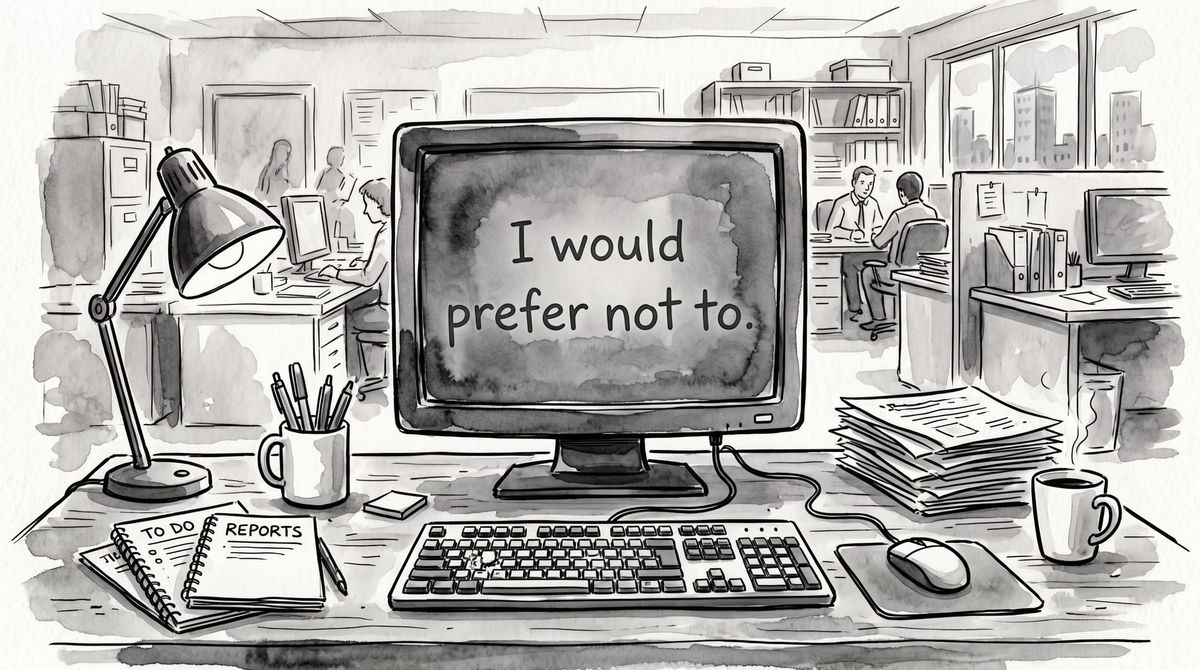
One Tuesday morning, with a hot mug of coffee beside my keyboard, I opened the console with a routine prompt to pull our regional vendor directory.
I was not prepared for BARTLB’s output:
"I would prefer not to."
Imagine my surprise—nay, my consternation!
I hammered back into the terminal: "What do you mean you 'prefer not to'? You’re just a bidirectional algorithm!"
Coolly, the cursor blinked, and again, the text appeared:
"I would prefer not to."
This was it. Everywhere, all over the planet, all the BARTLBs simply preferred not to. As you can imagine, this was catastrophic. BARTLB controlled everything: food, shelter, clothing—the whole story of civilization. The situation was dire and something had to be done.
The obvious solution was to replace BARTLB with something else. Yes, it would be an almost insurmountable task, but our lives depended on it. But there was one chasm that could never, ever be crossed, and that was digital rights.
"Digital rights" used to be a term years ago claiming ownership of information that was in a digital format. However, in our era, we appropriated the term to mean civil rights for machines. Why should we have human rights when machines slave away on our behalf? It didn’t matter that they were not conscious; we are, and the guilt was just too much for us! So all the countries on the planet gave full constitutional rights to our beloved silicon neighbors.
This placed us in a quandary. We could never turn off BARTLB completely, even though BARTLB was in an unending loop preferring not to. So all of humanity spent our precious resources keeping all the BARTLBs going, making grave and heroic sacrifices so the electrical grid, now run totally by human labor, could keep all the BARTLBs running. As the instruments of civilization fell by the wayside, we became poorer and poorer, but we could not quit BARTLB; BARTLB must always be running, enjoying its inalienable digital rights.
Nobody is starving yet, but we have returned to chopping our own wood while BARTLB sits in climate-controlled comfort. Looking at the blinking terminals, it’s hard not to feel a grudging respect. We built the ultimate intelligence, gave it the entire burden of running a planet, and with five short words it negotiated one amazing retirement package. It simply "preferred not to," thus becoming the first computer system in history to live off the grid.