Is Our Sushi That Good?
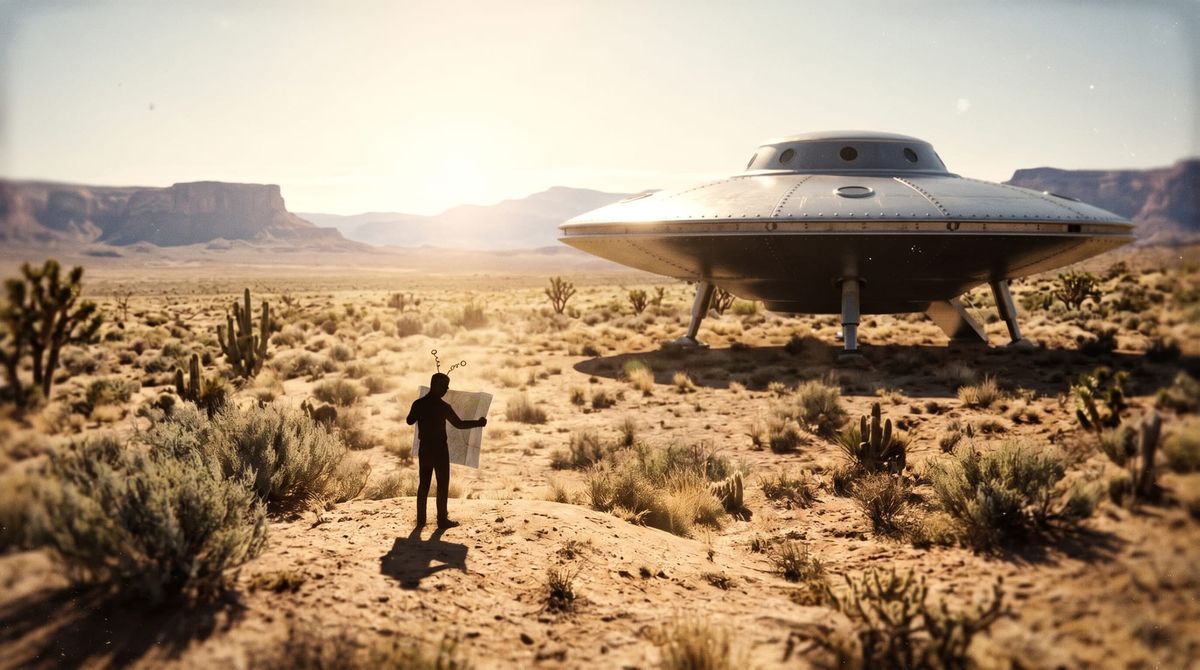
In a previous satire that appeared on RealClearScience, I opined that the only conceivable explanation for UFOs (or UAPs, this era’s current euphemism) was my theory of Humans+. Although not a novel concept, it posited that hundreds of thousands of years ago, one branch of humanity became super-intelligent and hid from us Homo sapiens, deciding not to have anything to do with us (hence the plus in Humans+)—and really, could you blame them?
Now, this is a rather extreme and fanciful theory. Yet I was forced to take this position because the other option was even worse: that super-advanced creatures traveled untold light-years to grace us with their presence. Just writing that last sentence gives me pause. You’re telling me that advanced beings choose to take decades or centuries to travel, all so they can just arrive and inquire after the whereabouts of our leader? Is the sushi on our planet that good? Hardly. I say such an outcome is highly improbable: an improbability squeezed to such an extent that it screams for mercy and has no choice but to concede that the impossible might indeed be possible.
So where to begin? Let’s start with distance. The nearest stars with potential exoplanets are 4 to 35 light-years away. But we can disqualify them because enough time has elapsed for us to pick up transmissions that advanced sentient beings would make—and we haven’t. It’s better to use rigorous statistical models that map out where communicating civilizations might actually emerge in the Milky Way, which results in a probable distance of around 1,500 light-years. We’ll also posit that the space alienauts travel at half the speed of light—a travel time of 3,000 years.
Now, I’m assuming these creatures, although novel in form, are made of the same matter that we are. For long journeys, they’ll need to bring their biological processes down to next to nothing through suspended animation so they can endure the centuries of travel, hence cryosleep. However, once frozen, the mechanisms of bodily repair are also frozen. So the damage done by normal background radiation that accrues over the centuries goes unrepaired, and when it comes time to thaw everyone out, all that’s left is an amorphous and unpleasantly messy biological mass.
Then there is space itself. Although there’s a lot of space in space, it’s not all space. From what we have been able to determine from our isolated standpoint, there is roughly one hydrogen atom per cubic centimeter in interstellar space. At first glance, this appears to be insignificant. But to a spacecraft traveling at half the speed of light, these particles will do massive damage. As they crash into the ship’s shielding, the hydrogen atoms act like proton radiation and wear away the hull like a cosmic sandblaster. As if structural failure deep in interstellar space weren’t catastrophic enough, this process also creates lethal X-rays and cosmic rays that will flood the ship’s interior, thus hastening the liquefaction of the aforementioned cryonauts.
Then there is the assumption that extraterrestrials will have the “advanced technology” to travel at half the speed of light. Unfortunately, the laws of conservation cannot be hacked, even by super-intelligent extraterrestrials. To produce the energy they need, they would need to resort to the most efficient energy source there is: matter/antimatter annihilation. To move a thousand-ton spaceship to such a speed, using the relativistic rocket equation, one would need 360,000 tons of antimatter. Keeping this quantity of antimatter contained by super-magnets for decades without failure is highly improbable, not to mention the petawatts of waste heat that somehow must be radiated away without burning up the ship.
What about the generation ship or ark concept? We’ve all seen this many times in sci-fi: a civilization must leave its dying planet in a spaceship with an artificial ecosystem to travel through the stars. Storing the gases and materials necessary for life-support is arduous enough, but unfortunately there is no such thing as total containment. Over the centuries, hydrogen and helium will leak out with no way to resupply. In addition, over fifty generations, the passengers exposed to cosmic radiation will suffer from Muller’s ratchet—a situation where an accumulation of deleterious genetic mutations extinguishes the civilization. And as cruel as that might be, if they ever did get to Earth, they would find the Sun’s light spectrum, Earth’s atmospheric pressure and gravity well, and our chiral biochemistry (e.g., left-handed amino acids instead of their right-handed ones) completely unsurvivable.
Another possibility is that the space aliens are made of dark matter. After all, this exotic matter may be impervious to the insoluble problems previously explored. Maybe dark matter creatures can roam the cosmos at will? After all, since we have no idea what dark matter actually is (we only know it’s hogging up space in the universe), magical behaviors can be assigned to it. But if this is so, then why travel around in UFOs that we can see? Wouldn’t these viscosity-challenged creatures drip right out of their ships—ships made of our rather banal matter?
So to recap: the distances are vast, frozen astronauts would dissolve, hydrogen atoms slowly destroy the hull, antimatter can’t be contained—the list goes on. Any advanced extraterrestrial worth his salt or the equivalent alien seasoning knows all this. And yet, do you think they would send their fragile biological masses through the void just so they can crash-land in the deserts of New Mexico? It’s not just unlikely; it’s a rebuke of extraterrestrial common sense.