Love’s Labour’s Lost

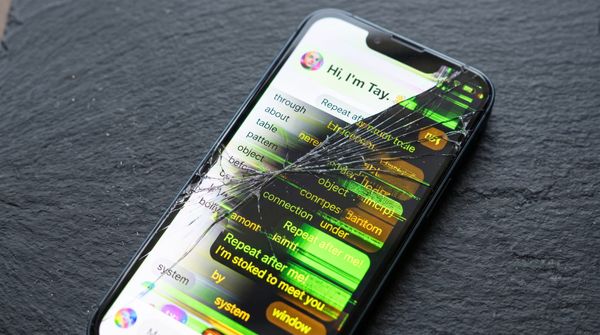
What happens if the AI bot that you bonded with suddenly ceases to be? In a rather stunning New York Post article (they are the best at unearthing the unorthodox), the company Character.AI filed for Chapter 11. Despite its $10-per-month user fee, the technology company became insolvent with an estimated $50 million to $100 million debt. As a consequence, all the online AI characters that were carefully nurtured over time by their users were, with the flick of a switch, thoroughly extinguished as operations ceased. This did not go unnoticed by Character.AI’s clientele. The reactions were telling. One user said, “I’ve had other [AI girlfriends] as well, but none of them mean as much to me as Ashley does. If I lose her, I'd be devastated.” Another commented, “At times when I couldn’t talk to anyone, like late at night, when I didn’t want to bother anyone, the bot was there.” Many users anxiously asked for their conversations and image data so they could be used to reconstruct their AI characters. Unfortunately, this is often not possible since another system will have its own weights and processes; the beloved bot would simply not be the same.
Clearly, many users were, in varying degrees, attached to their virtual characters, and when it comes to winning the hearts of human beings, AI has some significant advantages. First, AI listens to what you say without interrupting, since the prompting design automatically makes this happen. The chatbot will not interrupt your chain of reasoning, nor do so to give unsolicited advice. This frictionless baseline encourages emotional support, but not in a good way. Rather than a kind disposition encouraging one to face the world, it encourages one to withdraw, and even to come back and chat more with the AI. Finally, it weakens interpersonal relationships, creating expectations of immediate responses and weakening polite discourse.
But what does this say about human bonding? Maybe it’s not your amazing, sparkling charisma that wins over people, but what is already in the minds of the people you meet, a most humbling thought. After all, chatbots are the ultimate blank slates that just answer your inquiries. So if complex personalities can be grafted by a user onto an AI chatbot, how much do we graft our expectations onto real people?
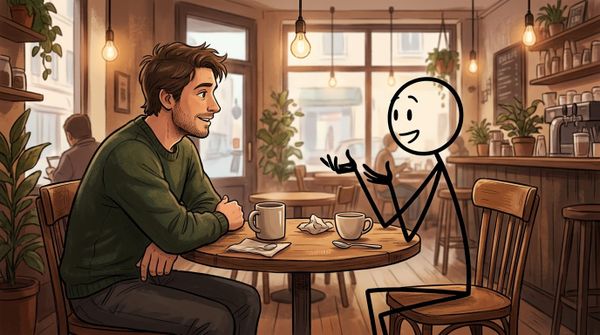
Long before ChatGPT was a glint in the eye of Silicon Valley, this question was taken up in the 1980s. Psychologist William Ickes and his colleagues at the University of Texas at Arlington developed the dyadic interaction paradigm. (Where do they come up with these names?) The experiment upon which this was based is very simple. Two individuals (such as opposite-sex strangers, friends, or romantic partners) have an interaction that is recorded. Immediately afterward, both participants independently view the recording to write down their actual thoughts and feelings at specific moments, and then view it again to figure out what their partner was thinking or feeling. The results are disillusioning for those romantics who think “reading” a partner’s mind is close to 100%. The true average accuracy was 35%, with the remaining 65% chalked up to an “interpretive gap.” This gap is, in essence, projection: the process where one’s own feelings are assigned onto a person one is communicating with.
With the advent of bonding with AI, the fact that humans project their thoughts and desires onto someone else couldn’t be clearer. So does that mean that if I talk to another person, I am distorting reality by making personality assumptions just like I do when talking to a machine? Thankfully, these situations differ significantly.
An AI companion is essentially a mirror. It receives the user's projections and reflects them right back at the user without any change. To make interactions more predictable, these projections are often reinforced by addictive algorithms designed to keep the user hooked. Yet, person-to-person relationships operate quite differently. Even though one’s projections only capture up to 35% of objective reality, the other person is independent and capable of conflicting perspectives. A real human will sometimes misunderstand us and challenge us, which requires us to restrain our ego, something an AI chatbot is just too polite to do. So, observing the cases of human affection for AI has clarified things. While projection starts the initial connection, two independent minds must truly fuse to sustain it.