The List of the Top Ten Bad Men of 1926 Begins
(This is the second in a four part series.)
As promised in part one, here is the beginning of 1926’s top ten evil men. Since I am not a historian, I allowed Gemini to create this list using its token weighting mechanism. The listing is merely a starting point, and it is up to us humans to pass final judgment. You can also argue that ordering historical figures by anti-achievements is artificial and an oversimplification of the chaotic sweep of human history. Yet such listings, in spite of their arbitrary order, invite us to measure these figures against one another, thus enriching our understanding of what happened.
10. Nero
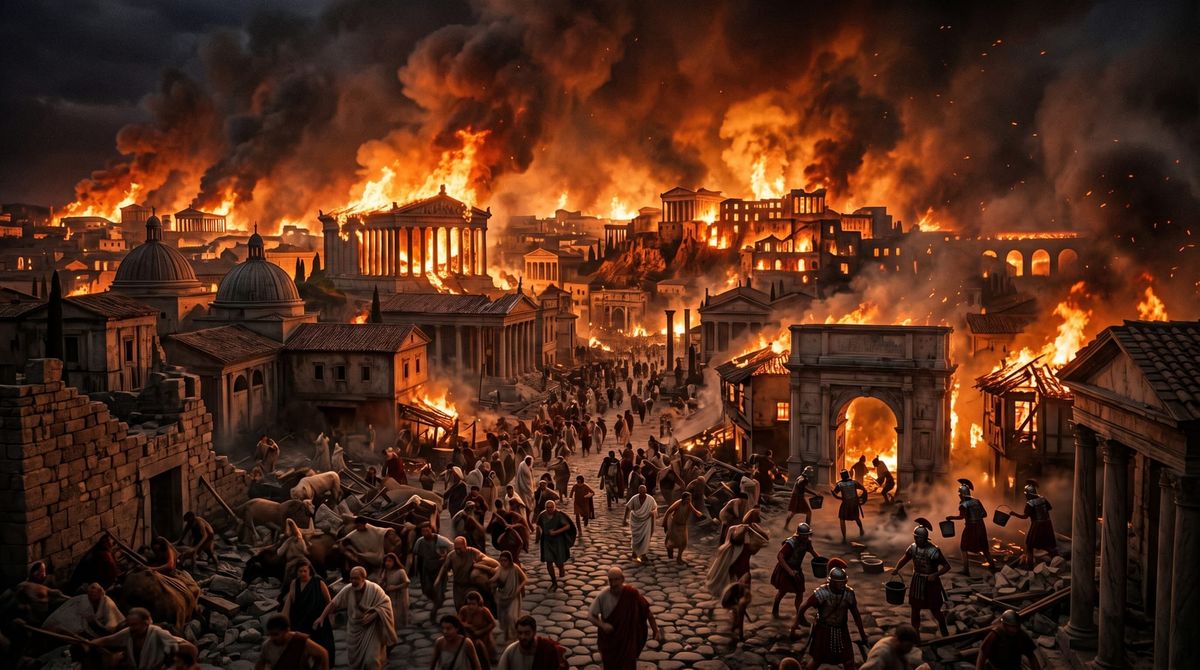
The classical background of those educated in 1926 should not be underestimated. They were well versed in all the ancient commentary that was very critical of Nero, creating an image of a tyrannical monster. Things are a little different now; we have a less one-sided view of him. But still, he was no sweetheart. After all, he murdered his tutor, Seneca, and his mother, as Will Durant points out in his widely read 1926 book, The Story of Philosophy. Also, the Italian intellectual Gaetano Salvemini often compared the rising Benito Mussolini to Nero to emphasize his megalomaniacal, violent profile to Western audiences. Although today’s historians place Nero more in line with the rough-and-tumble ways of the standard Roman emperor, a century ago he was the anachronistic, legendary mad violinist who fiddled while Rome burned.
9. Judas Iscariot
I expected Judas to be higher up on this list, in fact, number one. A century ago, religion was far more powerful, and with a smaller percentage of the population completing high school, I figured the influence of the ubiquitous Bible would place Judas in the forefront of everyone’s mind. So, perhaps this is where the degreed influence of the era’s chroniclers warps the true public mood.
Nevertheless, he remained the archetype of moral failure, the product of two thousand years of vilification as the ultimate betrayer of human character. In Dante’s Commedia, Judas Iscariot resides in the final circle of Hell at the center of the Earth, where he undergoes everlasting torture alongside Brutus and Cassius. I mean, one cannot receive press more negative than this! Yet, that did not stop others from trying. For instance, J. Middleton Murry’s The Life of Jesus presented a highly critical view of Judas, while Cecil B. DeMille’s The King of Kings utilized the relatively new medium of film to generate broader criticism of the man, especially in the entertainment press.
8. Chinggis Khaan (Genghis Khan)
History books of that era saw Chinggis Khaan (known in 1926 as Genghis Khan) simply as a merciless warrior, the personification of the “barbarian horde.” Today, much like Nero, his ruthlessness is somewhat balanced by his organizational talents, his flexible hierarchy that rewarded talent, and the Pax Mongolica. But then again, he did like to pile the skulls of his victims in pyramids. The histories published in 1926 saw him as a roaming pestilence that, if unchecked, could destroy civilizations that had become too decadent. Harold Lamb furthered the belief in Khaan as a calculating mass murderer in his serialized articles, which led to the huge 1927 bestseller, Genghis Khan.
As an aside, I can’t help but note that in the 1969 Star Trek episode The Savage Curtain, Chinggis Khaan makes an appearance. The Excalbian life-forms wanted to know about Earth’s moral conflict between good and evil. To achieve this, avatars of good and evil men and women were instantiated to battle each other to see if good wins over evil. The only recognizable evil man was Chinggis Khaan. You can see that the barbarian horde characterization still prevailed forty years later, with Khaan not even getting a single line to say. All he had to do was stand there and radiate pure evil.
7. Attila the Hun
Attila the Hun is another feared barbarian who attacked civilizations, specifically the Roman Empire. Many writers in the preceding millennia accentuated this fact (along with Alaric). But because of the recent conclusion of World War I, Attila the Hun was conflated with the defeated German nation. In fact, it didn’t help matters that Wilhelm II made a famous speech extolling Attila the Hun on July 27, 1900, at Bremerhaven:
Should you encounter the enemy, he will be defeated! No quarter will be given! Prisoners will not be taken! Whoever falls into your hands is forfeited. Just as a thousand years ago the Huns under their King Attila made a name for themselves, one that even today makes them seem mighty in history and legend, may the name German be affirmed by you in such a way in China that no Chinese will ever again dare to look cross-eyed at a German.
Because Attila’s name had been heavily weaponized to describe the most hated contemporary enemy of that time, Attila’s already substantial historical nefariousness was magnified and deeply internalized in the public mind of the 1920s.
Part three will continue with “evil-doers” six through four. Included in this group is a man who has largely slipped from modern consciousness, a figure I previously knew nothing about, which shows that every era defines “evil” by its own standards.