The Temporal Odd Couple
How do you describe human behavior and personality? With words, of course. And as it turns out, we have lots of them. The 100 billion Homo sapiens who have been on this planet for 50,000 years have diligently spent their time developing all sorts of words to describe all sorts of personalities. All through the ages, the minds of all cultures have obsessively described themselves, resulting in the ultimate lexicon via crowdsourcing—an embarrassment of syntactical riches.
So what if one took that wonderful data and performed a statistical analysis to see how all the adjectives that describe us are related? And what if you could condense them into a handful of dimensions that can quickly provide a broad description of an individual’s personality? Well, that is what the Big Five Personality Model does, and it’s, to my mind, sheer genius.
To summarize Jordan Peterson’s description:
The Five-Factor model is the most rigorous, practically and empirically validated model of personality we have... It was derived atheoretically from the statistical analysis of language itself. You can't just invent a new theory of personality now. The statistics are rock solid. Any new model or test that actually has any clinical validity just measures the same five things, but worse—any future theories are essentially just going to be a derivative of the Big Five.
If you are not familiar with its five dimensions, here is a quick rundown of the personality traits best remembered by the acronym OCEAN:
- Openness to experience reflects a person’s curiosity, creativity, and preference for novelty over routine.
- Conscientiousness measures self-discipline, industriousness, and orderliness, serving as one of the strongest psychological predictors of occupational and academic success,
- Extraversion gauges sociability, assertiveness, and the tendency to draw positive emotion from external stimulation.
- Agreeableness encompasses interpersonal tendencies, weighing compassion and politeness against skepticism, competitiveness, and bluntness.
- Neuroticism assesses emotional stability, tracking an individual’s vulnerability to negative emotions like anxiety, anger, and stress.
I only have anecdotal experience with the model, but for me, it has been very effective in engaging with highly varied personalities. But does it deal only with people? What about abstract concepts—specifically those that are ambiguous and hard to grasp?
Consider such concepts: the past, present, and future. I claim they all have "personalities" that we can better understand through the lens of the Big Five. I have long sensed an eternal tension between the past and future, and I think the Big Five Personality Model can clarify things.
First, a few words about the present. Although we spend every moment in that timeframe, it is not as irreducible as the past or future. As Steven Pinker points out, the perceptual present is actually a hybrid: a three-second window that integrates the immediate past with our anticipation of the future. The time lag between our perceptions and cognitive processing requires us to oscillate between the immediate past and present to make sense of the world. With that in mind, it’s best to concentrate on the present’s components: the personalities of the past and future.
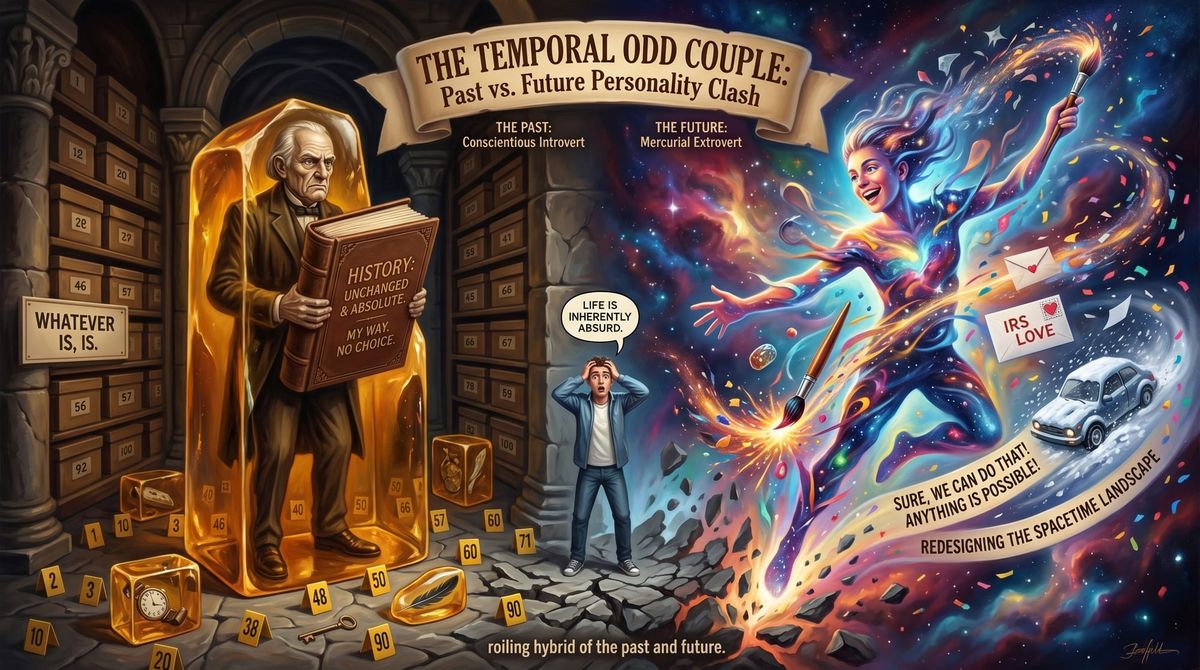
Let’s begin with the past. The first thing about the past is that it’s very conscientious. It puts everything in its place and it makes sure it stays there, metaphorically frozen in amber. Ever see a crime scene on a TV mystery? The past meticulously makes sure each piece of evidence stays precisely where it fell. As for openness, the past is very low on the scale. It’s not into looking for new things. Whatever is, is: that’s the past’s motto. And it certainly is not very creative since it accepts what happens and does not try to make any more of the past.
I’d say the past is definitely an introvert, always busy making sure history never changes. Hence it has no time for socializing. And I’d say it’s disagreeable—in fact, absolutely blunt. "This is the way things are," the past says. "It’s my way, and you have no choice in the matter." As for neuroticism, I place the past squarely in the middle. The unchanging ways of the past are absolute, so it’s neither a negative experience nor a positive one. It just is.
The future, on the other hand, is another creature altogether. It is pure creativity. When the future feels lazy, it merely rubber-stamps the path the past has laid out. But watch out when the future decides to redecorate the spacetime landscape. That IRS audit you just got in the mail out of the blue? That’s the future sending you its love. What about openness to new experiences? “Sure, we can do that," says the enthused future. "How about running out of gas in a snowstorm?"
The future is definitely an extrovert. It loves people and wants them to experience all the open-minded, creative adventures it has invented at the spur of the moment. As for conscientiousness, anything is possible at any time, so who has time for the steady world the conscientious require? As for neuroticism, I’ll let you, the reader, field that one as you contemplate what joy the future has brought to your life.
It’s clear from this exegesis that the past and future don’t get along. Thanks to the "clinical validity" of this model, we now know why: a simple clash of personalities, a temporal odd couple. The conscientious versus the mercurial, the staid versus the adventurer, the introvert versus the extrovert—how can they possibly get along? And we, trapped in the perpetual present, a roiling hybrid of the past and future, have a front-row seat to their personality quirks. It’s no wonder, then, we conclude life is inherently absurd.