Words Are Not Violence
A meme that has gained some currency lately is “words are violence.” I find this a corrosive and highly destructive concept. To put it pedantically, the reality is that words are words and violence is violence. Words and violence are two absolutely different things; mixing them up is a terrible mistake. A mere disagreement takes on the force of a physical assault, which makes honest dialogue impossible and introduces needless conflict into every debate.
If words are indeed violence, then wouldn’t just saying "good morning" be grounds to be punched in the nose? Wouldn’t all our conversations be immediately at Defcon 1? The most charitable thing I can say about “words are violence” is that it is imprecise, a sloppy way of saying that words can sometimes be used to incite violence. Of course, the syllabically balanced phrase “words are violence” is much easier to chant at rallies than “words can sometimes incite violence.” So I don’t expect this meme to disappear soon.
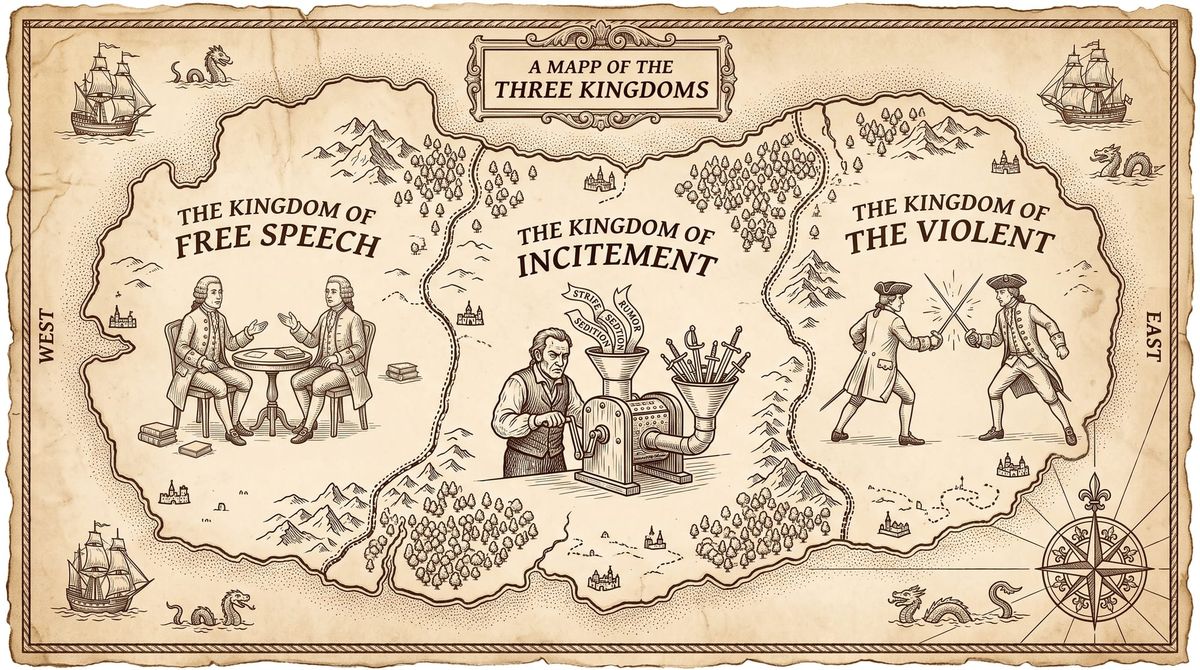
A good way to unravel the conflation of words and violence is to think of three kingdoms: the Kingdom of Free Speech, the Kingdom of Incitement, and the Kingdom of the Violent. These three kingdoms share one landmass with the Kingdom of the Violent on the east, the Kingdom of Free Speech on the west, and the Kingdom of Incitement in the center, serving as a buffer between the two worlds. In the Kingdom of Free Speech, you are free to express your thoughts to their fullest. Hopefully, a society that has agreed to such a system is virtuous enough—and wise enough—to use this rare gift as a way to build a world that reflects its aspirations. New constructive ideas, clarifications, and constructive criticisms are the norm in the Kingdom of Free Speech. Unfortunately, there are those with overactive lizard brains who insist on straining free speech to the fullest by formulating and spewing the most vile insults possible. In the Kingdom of Free Speech, this is permitted. It is up to the citizens of the kingdom to counter bad ideas with more free speech. Airing differences is the best antidote to violence.
Yet unfortunately, words can be used to make a different thing entirely: violence. In the Kingdom of Incitement, the angry populace spends all day calling for violent action. They yell "fire" in a crowded theater. They call for revenge against their neighbors. They cry out to hurt their politicians. Of course, reasonable minds may disagree on exactly where incitement begins. Think of a mobster walking into a shop and saying, "That's a nice business you have here. It would be a shame if it burned down." The words themselves mimic innocence, but the intent is clearly sinister. So does this rise to the level of incitement? Is it a demonstration of a violent intent and a high likelihood that it will be acted upon?
Perhaps not legally, but it shows how words can blur the lines. However, when irresponsible rhetoric drops the veil and explicitly incites, words forge violence, build it, construct it, mold it. While reckless speech can be used to pave the way for destruction, words and violence never occupy the same ground. Violence is its own force, an independent entity, untethered from whatever brought it into being. It is absolutely not words.
Living in a world of free speech is not for the faint of heart. It’s a dizzying roller coaster between the saints and devils of our society, a brutal up-close encounter with human behavior. But the alternative is grim. If free speech isn’t permitted to police itself, someone else will be found to order what you can think, say, or do. And assuredly, someone else can always be found.