Grammar Without Meaning
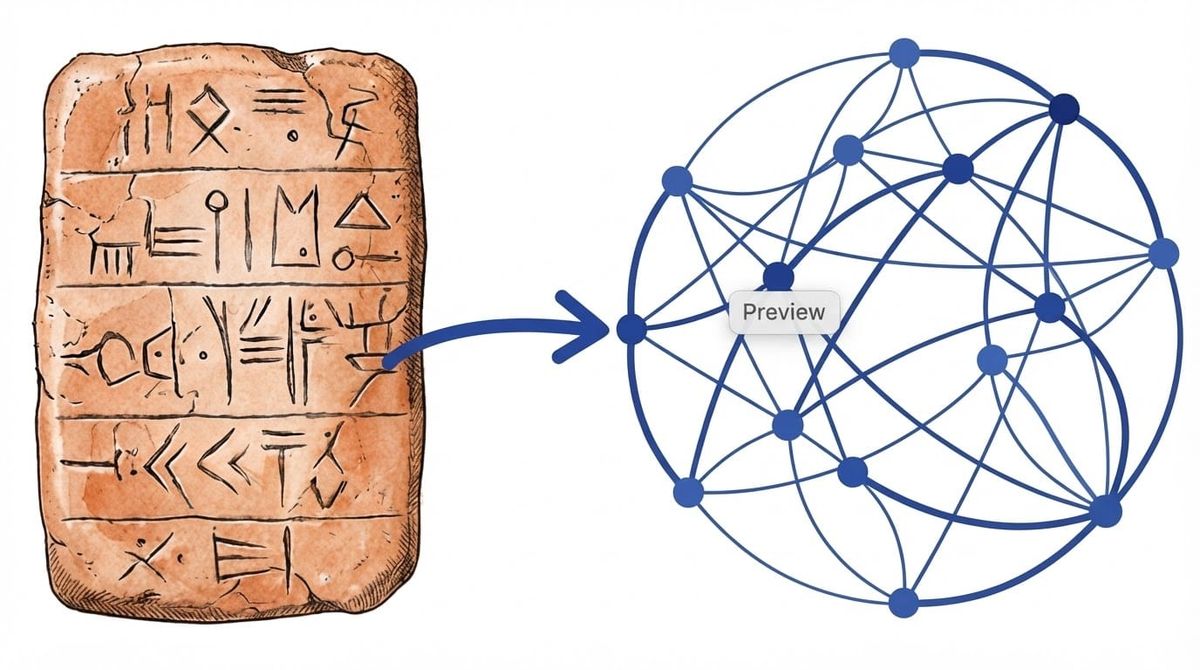
Remember algebra? You slaved away at school only to be told by your elders that you would never use it in real life. However, today your scholastic pain will be rewarded, because your hard-won knowledge will be very useful in understanding how dead languages are resurrected.
The most important takeaway from algebra isn’t those incredibly forgettable formulas (such as the slope of a line, y = mx + b), but the concept of the variable, an idea only recently adopted in the modern age. Previous eras relied on geometry, where every line and square was fixed—the shape itself was the value. But to us, the concept of a variable is second nature. So, with the formula x + y = z, we know that if you add x and y together, you’ll get z. But what these letters actually mean (area, speed, YouTube readership?) is up for grabs. In order to make any sense of what x, y, and z are, more information is needed.
A good example is the decoding of the Linear B script. For a fifty-year period (from 1900 to 1952), archaeologists and researchers painstakingly studied Linear B’s symbols, figuring out how the symbols related to one another, uncovering the outlines of its grammar. An archaeologist from the far future, stumbling across our alphabet for the first time, would work the exact same way. She would learn that the “symbol” e is the most frequently used, and the “symbol” h would frequently be found next to the “symbols” t and s. The fact that e is a vowel and h is a consonant would be unknown, as well as the sounds they make. Yet, nailing down the structure of a language is crucial to have in place before the meaning can be determined.
For Linear B, the revelation of meaning occurred in 1952. British architect Michael Ventris noted that certain symbols appeared heavily at Knossos on Crete but never at Pylos, Greece. He speculated that they were Cretan cities surviving into Classical Greek: Amnisos, Knossos, and Tylissos. During the summer, Ventris “plugged in” these symbols for the suspected cities, and after painstaking substitutions, results appeared. The architect discovered that Linear B was very close to Greek but used different symbols; hence, it could now be understood.
Today, there are projects in which AI is in the process of mapping ancient languages, mainly offering clarifications and improvements for those previously deciphered. But so far, it has been confined to symbol organization, not the search for meaning. So why can’t AI do what Ventris did? Find a connection to a known source? After all, the human knowledge that AI has access to is vast; there must be a key out there to bring a dead language back to life.
Even when an AI has mapped out the exact patterns of an unknown script, considerable roadblocks still prevent it from solving for x. Ancient language tools are not reachable because they only understand their own language, and many of the artifacts these tools use are not digitized yet. Also, computer searches looking for matches suffer from very large numbers of false connections, which are very time-consuming to factor out. And remember, these symbols are from a simple, tactile, iPhone-deprived world. Inscriptions on clay pots, seals, and little drawings quickly lose their meaning when they are stripped of their function and setting.
Worse still, once those artifacts are digitized, in some cases there is barely enough text left for a modern computer to analyze. For example, Llama, Meta’s LLM, uses 2 to 15 trillion tokens in its training. Surviving ancient texts are much smaller. The entirety of surviving Ancient Greek literature is 105 million words, still large enough for models to understand due to human translation, while an undeciphered script like Minoan Linear A has only 7,400 signs. Without a vast ocean of text to swim in, an AI cannot guess what Linear A’s symbols mean.
As for the 50 years of building a map for Linear B, I asked Gemini, if it had been around in 1910 when the majority of the Linear B tablets were excavated, how long it would have taken to build a map showing the relationship among the symbols. “About one afternoon,” it replied. “Roughly an hour or two to batch-process the photographs, followed by under five seconds of Python code to compute the entire algebraic grid.” This demonstrates the raw power that can be tapped to bring languages back to life. But what AI can’t do is make the fortuitous connection necessary to breathe life into a dead language—that’s still our job.