An Ancient Look At Self-Help

It has been remarked in the chaotic web-o-sphere that to some the Bible resembles a self-help book. And the first rule of the self-help genre is to describe the problem, and Genesis is very good at that. After all, the book of Genesis has an uncomfortable resemblance to the Jerry Springer show, except its actors wear sandals and cloaks.
It turns out that the self-help format of five steps and the sequence of events that unfolds in the Bible track very well:
Step One: Introduce the problem and promise solutions.
In the Bible, the problem is introduced with a bang—the sudden appearance of the universe inexplicably populated by us human beings. We then promptly illustrate what an issue we are by failing to follow simple instructions, such as not eating any apples. As for promising solutions, God makes a covenantal promise to bless and restore the nations.
Step Two: Chronicle a history of the reader’s urgent problems.
That’s easy! Genesis is awash in problems: Cain’s murder, the flood, Jacob’s deceit, Joseph framing his brothers—where to begin? It certainly takes an omniscient entity with unfathomable patience to make sense of that car wreck called humanity. And if no sense can be had, at least a triage of some kind can be cobbled together to moderate humankind’s chronic failings. Being good is a hard thing for humans to do, and Genesis dispassionately provides the evidence.
Step Three: Set up the reader to take action.
In Atomic Habits, the reader is encouraged to take action, but in tiny baby steps, the core premise of the book. The Bible, on the other hand, takes things to the opposite extreme. Rather than dividing a task into tiny parts (like writing only the first paragraph of a memo), Moses goes full force, takes the Israelites out of Egypt, and traipses around the desert for 40 years. So yes, there’s action, action of epic proportions.
Step Four: Describe the actions to take.
This brings us to Exodus 20, where the Ten Commandments are given. As for a description of the actions to take, they are more commanding than most self-help books since each actionable task begins with an intimidating “Thou shalt not.” There’s no soft sell here, as is the wont of self-help books, just hard-nosed expectations.
Step Five: Troubleshooting and confidence in a better future.
This is where things fall apart. While Moses is busy submitting to God on Mount Sinai, the Israelites have other ideas. They decide to build a golden calf and, if you permit the mixed metaphor, they trash all the commandments before the ink is dry on the stone tablets.
Of course, commandment breaking was quite a sport in Genesis. Who’s counting, one might ask, but I couldn’t resist, as this chart shows:
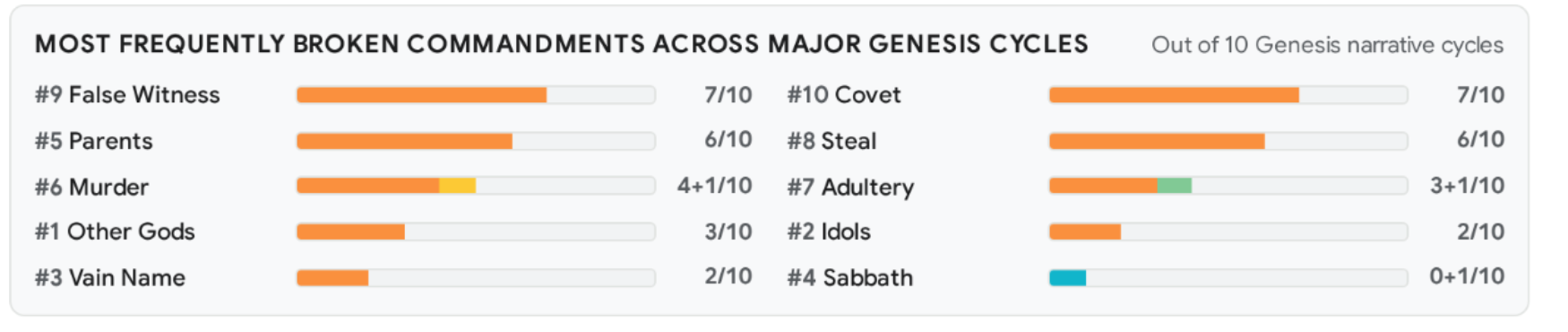
Bearing false witness and envy lead the list in human dysfunction. As anyone following social media knows, this is no surprise. Humankind seems pretty consistent over the millennia; it’s just that in biblical times, inscribing in stone made dogpiling less effective.
Yet, don’t the people in Genesis have an out? The Ten Commandments have not been prescribed yet, so isn’t it “game on” when it comes to human behavior? Not really. If one looks more closely, moral guidance is scattered around Genesis; it’s just that the Jerry Springer-like antics draw our attention, the same attention that showered high ratings Mr. Springer’s way. For example, God prohibits murder as he warns Cain (Genesis 4:7), King Abimelech of Gerar is warned by God in a dream not to take a married woman as a wife (Genesis 20:1–9), and the king himself makes Abraham swear by God “that you will not deal falsely with me,” a societal acknowledgment not to bear false witness. It’s not until Exodus that God decides to be more thorough and organized by assembling a list of commandments. Perhaps He thought people would relate better to lists, as David Wallechinsky found in his popular series.
Although the Bible does function surprisingly well as a self-help manual, to consider it such misses the point. The Bible is not intended to be secular; to Christians, it’s the word of God. The Bible’s purpose is to draw believers’ attention away from this mortal coil and encourage observation of the deeper, spiritual world that is all around them. The danger of treating the Bible solely as a self-help book is to tailor it in service of earthly comfort, a manageable guide to better living rather than in service of a transcendent God. It risks, ironically, being converted into a golden calf, a graven image mirroring human desires. Yet even in that secondary role, as a guide to ordinary decency, it endures.