The Annual Zero Central Park Tenant Meeting
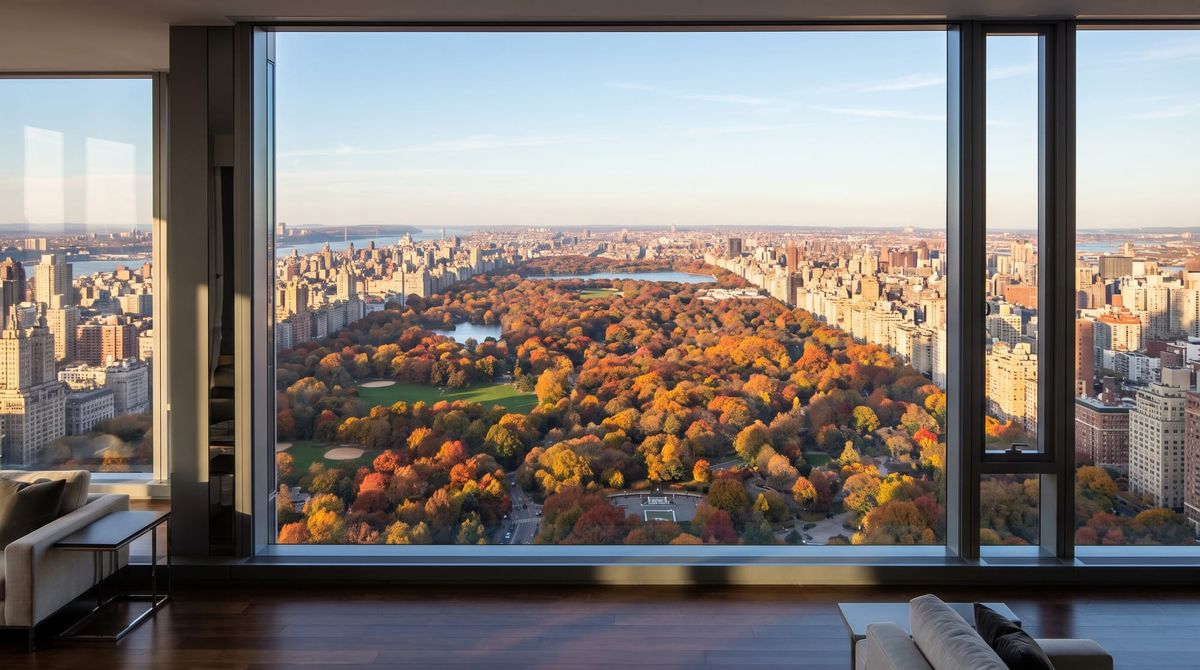
Cliff always braced for his ears to pop on this annual gig in Midtown Manhattan. The elevator was swift, hurtling him up toward the 111th floor at an uncomfortable speed. But it was worth it, because when the doors slid open, he saw that spectacular view: Central Park, deep in autumn, bedecked in glorious color. The penthouse itself was bare, stripped down to concrete and packed with racks of high-end electronic equipment; it was Cliff’s job to bring them back to life.
Zero Central Park had an unusual history. A savvy developer discovered that a 60-by-85-foot patch of land just on the park side of 59th Street was not owned by the City of New York, but held privately. Diligently, he tracked down the deed holder—who didn’t even realize he owned it—bought it for a song (including 1,277 feet of vertical air rights), and built a symphony of a skyscraper. Because the city grid couldn't accommodate a conventional street number, the unorthodox address of Zero Central Park was reluctantly agreed upon. To the developer’s delight, this numerical quirk carried immense cachet, the very sensibility that became the building’s raison d’être.
Because the unit owners couldn't get enough of the prestige of overlooking the park (with the added bonus of obstructing the views of rival billionaires), the condo board enacted a strict rule requiring all annual meetings to take place on-site in New York City. The mandate was completely absurd; nobody actually lived in the tower. Zero Central Park was merely a vault in the sky where the wealthy parked their capital away, especially those from countries with unstable currencies. Yet the rule stood. Even though the condo board members were scattered across the globe, the physical server routing their feeds hummed right here on the 111th floor, legally placing everyone’s "presence" in the room. The board that ran the meeting wasn’t populated by individuals, but was made up of a conglomerate of conglomerates. Any legal entity you can imagine was represented on the board: blind trusts, S-corps, assorted offshore entities.
Soon the meeting began. Cliff sat before the large monitor, making sure all the participants could see, hear, and participate in the proceedings without incident. Cliff could also see and hear everything in the proceedings; that's what non-disclosure agreements are for. The meeting moved forward with the reading of the minutes and the financial condition of the tower (“Our finances are good,” was the understated assessment). Finally, the floor was opened so that the tenants could voice their concerns.
“Permit me to start,” said Sir Charles Plantagenet. “The film producer in the apartment above me always has those awful parties.”
“That’s not true,” responded the presumed producer. “I’m never there, so what are you talking about?”
“Of course, my dear sir, you’re never there,” responded Mr. Plantagenet. “I’m never there either. But it’s a known fact that you throw parties and I don’t want one over my head.”
“Okay, next time I’m not there I’ll keep it down,” replied the producer.
A reedy, nasal voice cut in. “Perhaps we can move on?” it whined.
Everyone recognized John George. It wasn’t just having a last name that is essentially a first name that signaled his prominence; he was the self-styled “AI King,” a moniker he chose with the calculated, retro irony of a late-night infomercial pitchman. Mr. George considered himself the undisputed master of modern machine learning. Tonight, however, his grievances were decidedly more down to earth.
“I want to talk about the garbage chute,” he announced.
“Please proceed,” replied the blind trust, caught off guard by the detour.
“This tower stands 1,277 feet high,” George lectured. “At that height, any refuse dropped down the shaft reaches approximately ninety-seven percent of its terminal velocity after descending only two to three hundred feet—even accounting for the turbulent updrafts inside the chute.”
“You’re never even in residence,” interjected the Delaware S-corp. “How would you know that?”
Yes, thought Cliff. How does one know? If refuse falls down an empty chute and no one hears it, does it make a sound?
“Of course I know!” George snapped, indignant. “I can calculate the exact acoustic output of a bathroom scale shattering on the chute’s basement floor. And I did just that, while Mr. Finance was taking on Mr. Hollywood.”
Cliff suspected George didn’t care about the chute at all; he simply wanted a captive audience to know that he understood terminal velocity, the resistance of the drafts in the chute, and the concept of free fall.
The concerns continued: doorman personality clashes, monitoring delivery people, polishing the Egyptian marble in the lobby. All were virtually seen from afar, all had some virtual probability of happening. It was virtually much ado about virtually nothing, the core lifeblood of an empty tower.
Soon the meeting was over, and Cliff began tearing everything down. They say the rich are different from you and me. Cliff wasn’t so sure of that; the tenants seemed as absorbed by the indignant trifles of everyday life as their much less affluent neighbors. The 1,200-foot tower was essentially a ghost town of squabbling ghosts, a vertical cavern full of the echoes of human pettiness. Still, it was a great gig. After all, there was that fantastic view of Central Park.