Boxed Up Energy
The pandemic was six years ago—a somewhat faded memory, but not forgotten. It was a time of isolation and frustration as governments around the world ordered lockdowns. This hit musicians especially hard. Not only were gigs and concerts canceled, but a means of deeply personal expression was stripped away. A lawyer could continue to work at a quarantined desk in a manner reasonably approximating an office environment. However, a musician alone in his living room could not perform in an ensemble or in front of an appreciative audience.
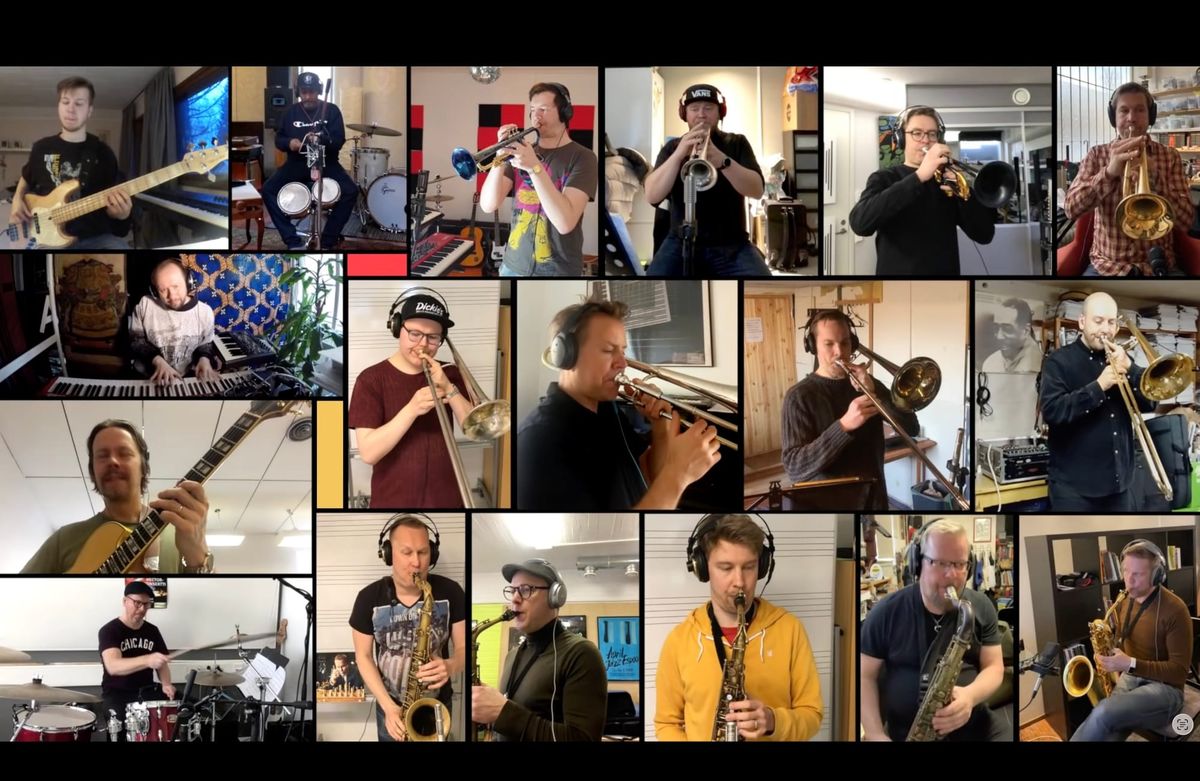
Finnish saxophonist William Suvanne, tired of canceled concerts, decided to form a group of highly skilled performers. Suvanne recruited 17 of Finland’s top jazz and session musicians, along with featured vocalists and professional dancers, to create a remote big band performance. He noted:
We’ve already spent several weeks apart without any live performances or group rehearsals. I invited other musicians to join in, they jumped at the idea, and the wonderful result will soon be out for everyone to see.
When I first saw this performance on YouTube, I thought they all played together in real time. But a moment’s reflection proved otherwise. Even though it is conceivable (but unlikely) that a studio could have a fiber-optic connection to handle all the inputs of HD video simultaneously, the latency alone across each player’s home internet connection would introduce delays that would make real-time ensemble performance impossible.
For the this performance, Mr. Suvanne chose Nick Lane’s remarkable arrangement of Josef Zawinul’s “Birdland,” an arrangement often performed by Maynard Ferguson’s big band. Yet there were formidable obstacles to creating a remote performance. Most of all, musicians are accustomed to real-time feedback from fellow performers on stage. This would be difficult to accomplish, to say the least, with everyone quarantined in their living rooms. Clearly, a structure of some sort had to be used. The keyboardist, Antti Kujanpää, provided the answer in the comments section of the YouTube performance:
Click track! Bass, drums, keyboards, then lead of every section and so on. I think solos were the last tracks to be played, not completely sure about that.
While simple in theory, the overdubbing created such a convincing illusion of a simultaneous performance that I momentarily forgot it was recorded in layers.
After the click track was laid down, the rhythm section added its parts one by one. In particular, I felt the drummer’s intuition was remarkable. Drum fills between phrases are reactive by nature; by sensing the energy of the group, the drummer improvises these flourishes. Yet in this situation, the drummer went first and had to anticipate and place his fills before anyone else had played. Anssi Sopanen, the drummer, pulled this off so convincingly that in the final mix, it appears as though he were reacting in real time to what the other musicians were playing.
The next step was to add the horns. The first players, the section leaders, had to perform along with a barren rhythm track. As more instrumentalists added their parts, each musician had to adjust independently, whereas musicians normally modulate their playing together in real time. An impressive example of this occurred during the trombone theme entrance: the second trombone's overdub matched the timing and intonation of the lead trombone perfectly, creating the illusion of seamless, live collaboration.
Once all the tracks were recorded, they had to be mixed. Because the project was not recorded in a professional studio, room acoustics varied widely across each performer's space. The mixing engineer had to compensate carefully to homogenize the sound environments. Incidentally, I suspect, along with Antti Kujanpää, that the soloists, Varre Vartiainen on guitar and Aleksi Ahoniemi on tenor saxophone, recorded last, as they can occasionally be seen silently singing the melody along with the recorded tracks.
All in all, it’s a world-class performance of a legendary chart. Yet, perhaps the most poignant part is the end. As the music finishes and the video frames disappear one by one, the vibrant illusion collapses back into the quiet confines of empty rooms, returning each band member from the joyous world of communal music-making to more months of desultory solitude. Still, for six brief minutes, they escaped their isolation, the heavy stillness of their world momentarily forgotten.