Everybody's Face But Their Own
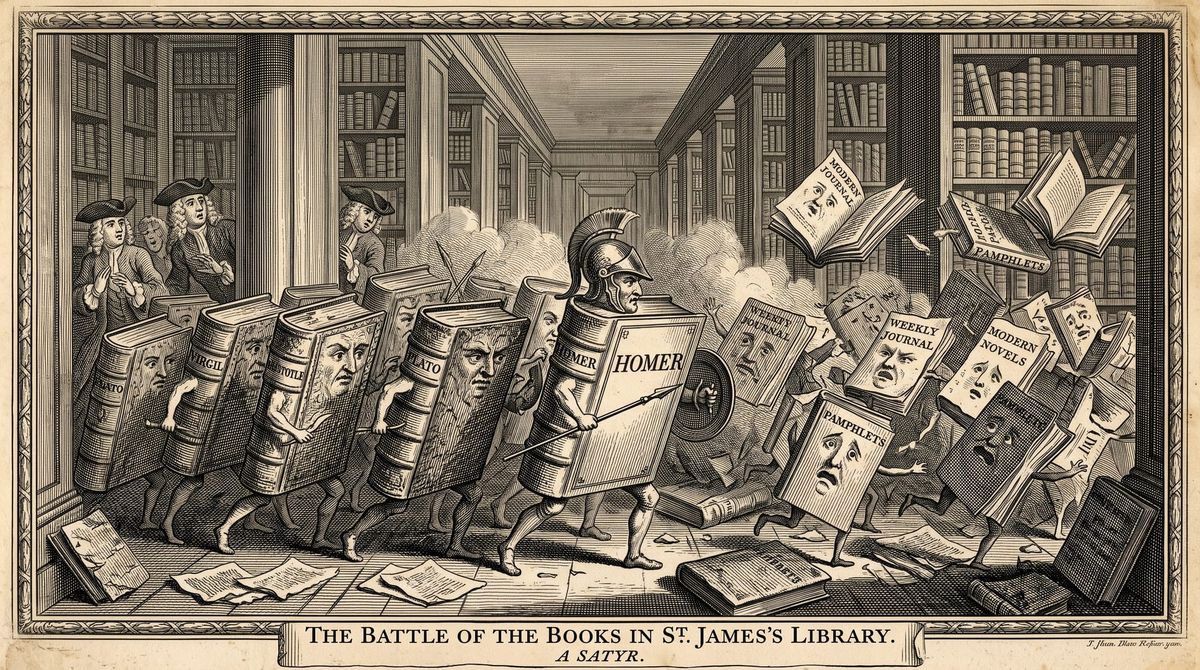
Satire is a sort of glass, wherein beholders do generally discover everybody's face but their own; which is the chief reason for that kind of reception it meets in the world, and that so very few are offended with it.
– Jonathan Swift, preface to The Battle of the Books (1704)
Imagine going on a tear. It’s been a bad couple of days, and you just let loose a diatribe of woe right at your friend. The car won’t work, the iPhone is shorting out, the boss is angry as ever. You go on and on as your conversational partner gets progressively annoyed. Soon he has had enough, and caustically informs you, “It’s not all about you.”
A fair point. We can get overinvolved in our own problems very easily and forget the larger picture. But in one certain case, one type of communication, it is all about the other guy. And that case is satire.
If you read my piece The Bane of the Elite, and you're deeply ensconced in the elite (well done!), I’m certain you did not recognize yourself. In fact, even I didn’t recognize myself. I am nowhere hovering about the heights of privilege, but I am guilty of a “piling-on of criticisms, infused with over-refined snark.” And yet, I don’t see myself here. It’s only other people, of course.
What blinds us is naive realism, the illusion that each of us sees the world completely objectively. Since we are convinced that our take is neutral, conflicting opinions just seem wrong, or worst, as illustrated in the aforementioned essay, naive. This way of thinking makes it harder to see one's biases and flaws. So if satire enters one’s world, it can’t possibly be about you—it’s gotta be the other guy.
It gets worse when you realize how this actually works. When we evaluate ourselves, we look inward at our pure motives and honest intentions, concluding we are reasonable people just trying to do the right thing. But when we evaluate other people, we only see their actions, actions that constantly clash with ours. So when satire holds up a mirror to mock humanity, our brain decides the caricature on the page belongs to that insufferable neighbor down the street, while our own spotless conscience gets a free pass.
On a larger scale, there is the Third-Person Effect (TPE). TPE is the belief that mass media messages have a much stronger impact on others than on oneself. We are, of course, objective, savvy, analytical, and immune. No one is pushing our buttons! But the assumption is that the general public, especially those with opposing views, are easily taken in. (“Where do you get these people? I mean, really!”) This ainspires censorship because although the individual can weather the exposure of contrary material, others cannot.
Ironically enough, this seems to hurt the goal of the satirist. She sees something out of whack, and if enough satire is inputted, the flaw in her world would become glaringly apparent. But to no avail. The reader will laugh, chuckle, and conclude that it’s a crazy world overflowing with dysfunctional people. But the reader will find solace that he is gifted with rare objectiveness that others seem to lack.
There is a saving grace. In order to live on this planet, individuals need the illusion of objectivity. Constantly double-checking our behavior while performing the many things we have to do would paralyze us, even preventing our survival. It’s best to go with the objectivity, but from time to time remember that one is not bias-free and the other guy just might be right.