Music's Hidden Plot
Unfortunately, symphonic and chamber music forms are not taught at all in school. In English class, we learn all the analytical terms for literature: foreshadowing, similes, irony, and character development. But we learn nothing for music. Terms such as sonata-allegro form, rondo, and the development section; none of these are imparted to eager young minds.
That aside, why does classical music even have these forms? Is it something that intellectuals arbitrarily created, or is it something more? I believe it is based on something very basic: the fundamental desire of humans to tell a story. To be clear, I’m not talking about a Strauss tone poem like Eine Alpensinfonie (An Alpine Symphony), which tells the literal story of ascending a mountain, but a story told using the logic of musical figures.
The Monomyth, famously detailed by Joseph Campbell, outlines the hero story found in many civilizations. In short, it follows a protagonist who ventures out from their ordinary world into a supernatural realm, overcomes intense trials, and returns home transformed, often with the gift of wisdom. This pattern is everywhere: mythologies, religious texts, and even overwrought Hollywood extravaganzas.
But what does this have to do with music? There are no dragons in the orchestra (except possibly in the brass section…), just instrumentalists trying to make some music. What sort of story can a symphony speak of?
To understand how abstract sounds can mirror a hero's journey, we can look to the music of the Classical era. A wonderful example is the first movement of Mozart's Symphony No. 40 in G minor. The form that it follows is the sonata-allegro form, as shown in this chart:
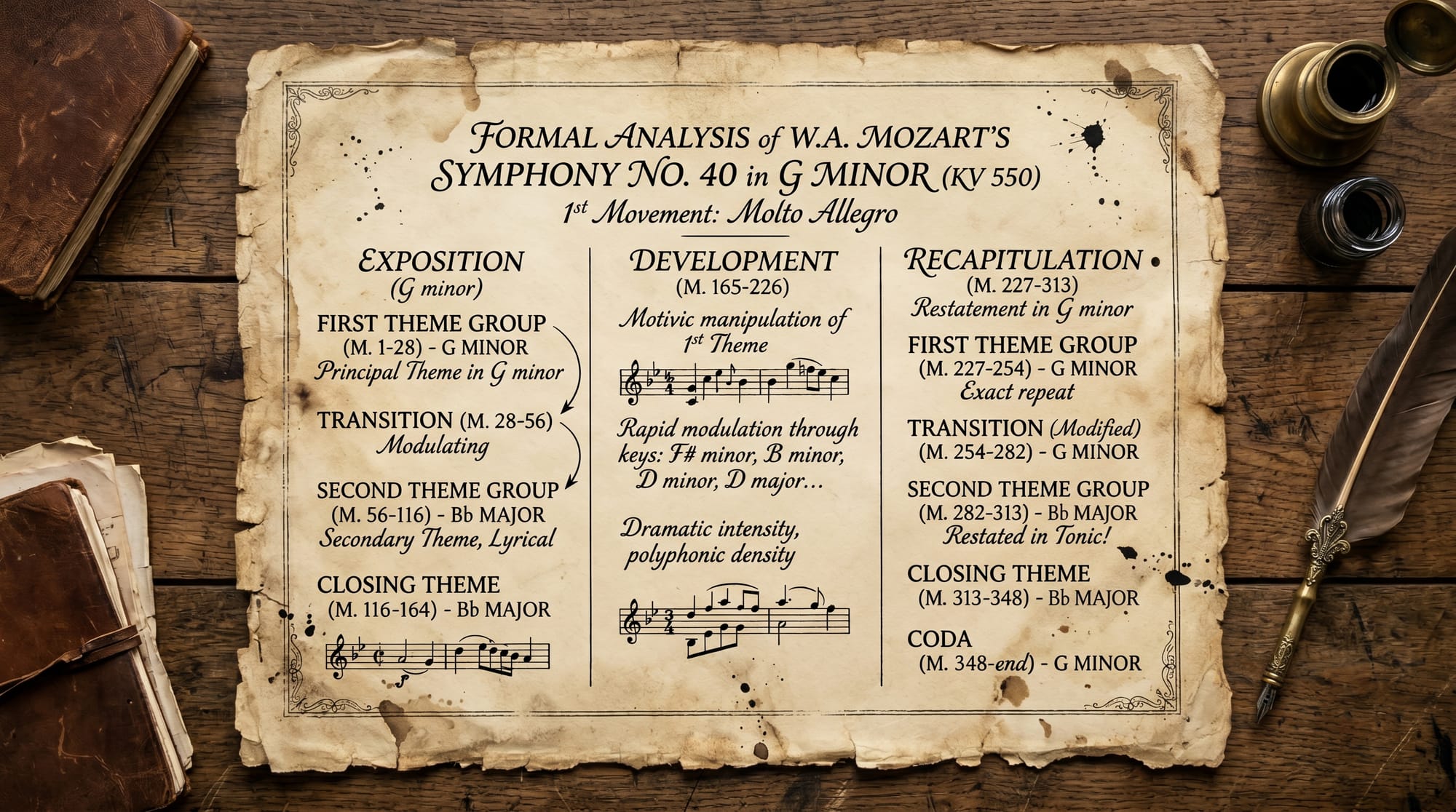
The complete details of the sonata-allegro form are beyond the scope of this essay. The point is to show that much changes beyond the theme’s statement. Using the story analogy, the main theme of the symphony can be thought of as the hero. But this is only the underlying metaphor. The desire for an unfolding story is translated into musical phrases; words have no meaning here. To hear how this musical narrative begins, listen to the main theme.
But a story that simply stares at the hero is meaningless. The same goes for a theme. The theme isn’t placed in an infinite loop where it can be listened to forever. Something must happen, and in Mozart’s symphony, something does. Like the hero in the Monomyth, the theme goes on its own musical quest. It doesn’t climb mountains or save heroines—it can’t do that, it’s music! But within the confines of musical syntax, it does indeed go on an adventure. The comfort zone of the main theme is left via an agitated transitional section. This leads to a new, serene world that appears in the guise of the secondary theme. It’s a musical travelogue of sound and emotion solely powered by musical syntax.
Trial and tribulation await the theme in the development section. The theme is stated but sinks slowly into a quicksand of lower keys. Then it is tossed about like a volleyball from register to register, the musical equivalent of an arduous trial. Again, there are no princesses or dragons, but through the genius of Mozart's musical handiwork, a feeling of drama and uncertainty prevails just by the use of musical forms.
Finally, the trial is over, and we hear the recapitulation. The theme has weathered the transformations and seems to back to its old self. But this is deceiving because an intense transition follows, the scars of the adventure. And when the secondary theme returns, it is in a new key (it’s hard to hear and much easier to spot in the musical score). Perhaps this is a musical version of newfound wisdom? A nod to the convention where the protagonist returns changed in some way?
So yes, these forms do matter. They support the need for storytelling even in a completely non-linguistic form of communication called music. Henceforth, the next time you listen to a symphony (if you choose to do so), listen for the musical adventure. Remember, it's on the music’s terms. The music decides whether to become lyrical, agitated, broken into bits, elongated, slammed into different keys, forced into fugal purgatory, reharmonized, restored, and then reharmonized again. Using the ingenious musical devices engineered over the centuries, it leaves the comforts of its home key, visits the sonic world of its adversaries, fights or joins with them, and comes back a little bit changed, usually in another key. It truly is an adventure available at your concert hall—without the dragons.