On Tailgating
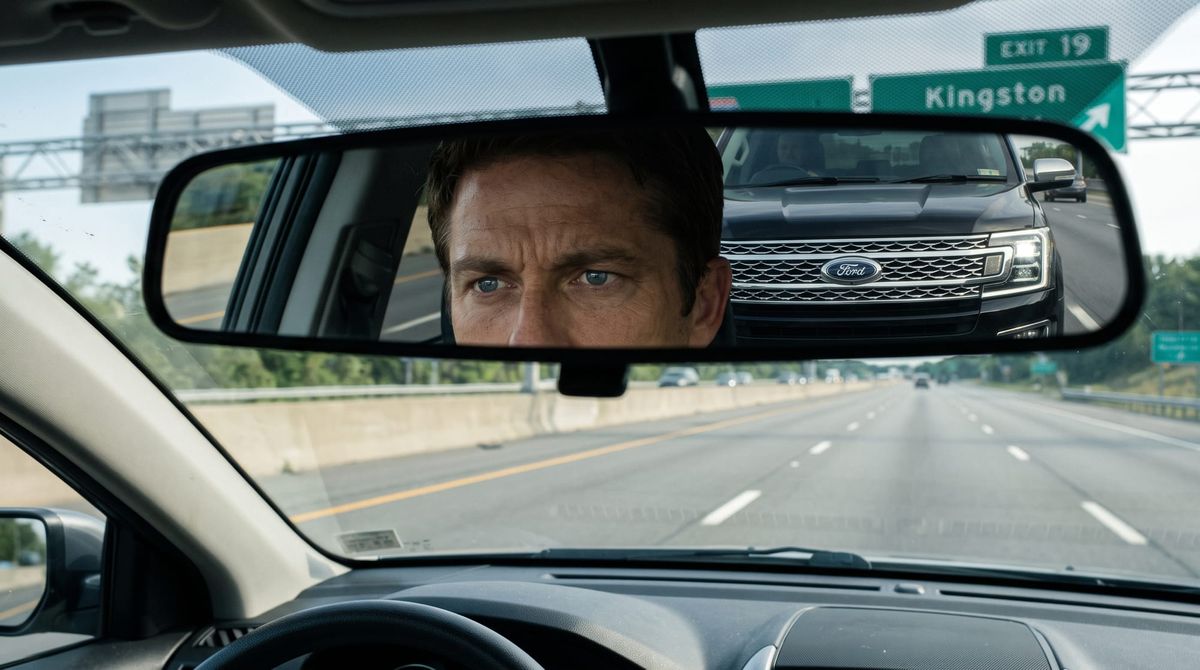
I hate tailgaters. They are the bane of my existence. I generally stay in the slow lane when I am on the New York State Thruway, ground zero for tailgating. However, even though I drive at a steady, modest pace, there are those who are just too slow. So sometimes I venture out into the fast lane for just enough time to pass. But of course, some tailgater-nator immediately appears in the rearview mirror with a grill the size of a Weber Summit gas grill. It is driving right up my tailpipe, flashing its Xenon lights like a maniac.
“Get out of my way,” the car seemingly roars. “My existence can no longer be inconvenienced by your presence!”
“Sociopath!” I bark.
I find that the three syllables of the word sociopath are useful, since each syllable (SO-cio-path) progressively cools my anger. I find that the rude Germanics are just too brief to be effective.
Having passed the slow car in front of me, I retreat to the slow lane. And of course, Mr. Grill zooms off into the future, vowing to eliminate all who dare to cross his path.
I often wonder, what kind of people are these? If a tailgater stepped outside the car bubble and met me in a grocery line, would he cut in line just for fun? Or would he actually be timid, turning into a maniac only when he feels the urge to be born to be free?
As it turns out, it is not that cut and dry. First of all, there are the situational vs. the serial tailgaters—the bad and the ugly (there is no good in tailgating). The situational tailgater only tailgates when he feels it is necessary; for example, when he is late for something. These drivers are quite dangerous because they have a goal that they must meet and will do what it takes to meet it. They transmogrify into an impatient, physical tailgating tool to "encourage" the obstacle (that’s you!) to move out of the way. However, after it is all over and the meeting time has been met, their aggressive behavior will most likely dissipate back into more polite behavioral norms. Still, it’s not good. These situational tailgaters are in a fraught mood, which makes them hazardous.
Would a serial tailgater be safer? By definition, he is in practice, right? He can move up to the back of your car and just suspend there, in total control? Well, that’s not so good because you have to remember that the serial tailgater lacks basic empathy or consideration for other human beings. Try to remember that when that giant grill is inches away.
Serial tailgaters don’t like the rules. Rules are not what they do. Speed limits? Traffic signs? These are for other people, not them. They often exhibit traits you don’t want from a driver of a car almost in your back seat: low impulse control, poor emotional regulation, and a chronic, unyielding need for instant gratification. So I bet these people would also cut in a grocery line and lift a Snickers bar to boot.
But I wouldn’t be complete without the weavers, the heirs of the serial tailgaters. They seemed to appear suddenly in the last decade, and studies by the AAA Foundation for Traffic Safety bear this out. They found that aggressive driving maneuvers such as cutting off other vehicles surged by over 67% between 2016 and 2025. And they don’t even bother to signal. Imagine!
Traffic weaving has surged because modern driving habits, technology, and a lack of enforcement have combined to encourage reckless behavior. Empty roads during pandemic lockdowns normalized risky speeds. At the same time, distracted drivers camping in the left lane frustrate weavers, who must do what has to be done. Phone navigation apps subtly push people to "beat the clock" by constantly switching lanes to shave seconds off their arrival time. And don’t forget high-tech cars are better than ever, giving drivers a false sense of security and overconfidence that makes dangerous weaving feel absolutely safe.
Unfortunately, these behaviors on the road may awaken our own inner “situational” bad behavior. Don’t do anything rash like slam on the brakes. Remember, they are beyond your control and you can’t change them—they are lost in a world of their own making. Ease out of lanes if there is a tailgater. And if there are weavers, hold steady until they are out of range. Still, if you wish to bark “sociopath” as a relief valve, I bequeath that to you. You’ll be surprised how well it works.