My Muse's Performance Appraisal

People often ask me what my characters do when they are off-screen. I can honestly tell them that I simply do not know; I am entirely dependent on the visitation of my muse, Clio, an inspirational creature born in ancient times. She comes and goes on her own schedule, leaving me with no control over her peregrinations. It matters little where I am—whether at home in front of my computer or standing in a grocery line—for when she feels inspired to inspire, insight descends.
But alas, creeping corporate policy invades everywhere, even the magical spheres of existence. Apparently, the Muses are now subject to the same soul-sucking performance appraisals we mortals must suffer through. On her last visit, my muse, Clio, relayed the subdued horror of it all.
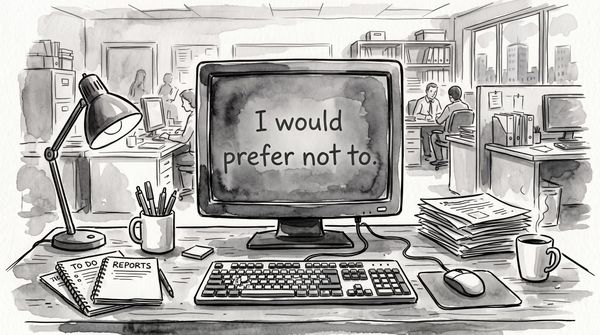
The “office” where the performance appraisal took place is simply an airy realm filled with beautiful, bright white light. At a glass table sat Clio’s boss, a man in his forties with graying temples. Seated across from him was the blonde Clio, dressed in a flowing white dress with a garland of flowers in her hair, standard-issue muse attire.
“Your early work has been absolutely exemplary, Clio,” the boss said. “Your work on Dante’s Divine Comedy has become the gold standard of the muse world. I understand you alone crafted the sixth circle of heretics.”
“That’s right, sir,” Clio said with her customary perkiness. “Right smack in the middle of the fifth circle of the wrathful and the seventh circle of the violent. It just felt so right.”
“Indeed. And later on, you came up with Marley’s chain in A Christmas Carol by Charles Dickens. A very prescient metaphor, Clio. To this day, humans are forging chains of personal information on X.com that they will one day come to regret as much as Marley did.”
“Thank you, sir.”
The boss took a sip of coffee, apparently flown in by angels. “I see you also have an interest in physics.”
“That’s right. Einstein originally had E = mc3 because he forgot to carry the one earlier in his calculations. ’Twas I who set him straight.”
“Again, well done.” At that point, the interviewer’s demeanor became more grave. “Then there’s the twentieth century.” The boss paused for a moment and let out a sigh. Clearly annoyed, he looked straight at Clio. “I mean, Clio, Gilligan’s Island? Really?”
Clio did not reply. The interviewer continued. “I’m informed you changed the title song lyrics of the first season from ‘and the rest’ to ‘the Professor and Mary Ann.’ It doesn’t even rhyme!”
“It’s a homonym. That’s legal.”
“Well, maybe for Milton, but not those Hollywood types,” sniffed the interviewer. “There are other very troubling failures of inspiration here, but we must move on.” He turned the page, put on his glasses, and squinted at his report. “What about this Laconil character?”
Clio was silent and looked away, embarrassed.
“And?” he asked.
“Well, he’s kind of cute,” she said in a low voice.
“Clio, please! We must maintain professional standards.”
“It’s not my fault that he insists on being so cute!” protested Clio.
“Regardless, Clio, let’s talk about the title of the book you subconsciously planted in his embarrassing pliant mind: Immortality Is Really Forever. What kind of a title is that? Avoiding such redundancy is Muse 101!”
Clio was prepared for this. “Well, as you may know, sir, our fellow muses didn’t really fully think through what immortality really is. Often they’d create a character 200 years old and call her immortal. To me, sir, that’s just good genes. I wanted to point out the true, unrelenting, eonic nature of time that the immortal must traverse.”
“And you hoped to express this in the title Immortality Is Really Forever?”
“Well,” Clio said with a mirthful countenance, “you couldn’t very well put all that I just told you in a title!”
“True. True.”
The interviewer put down his papers and leaned back in his chair, staring off into space for a moment as if deep in thought. After reaching what appeared to be a silent conclusion, he finally spoke.
“I think you may be on to something, Clio. This Laconil fellow needs our help, so keep an eye on him.”
“You can count on me, sir! I’ll keep providing Bob, I mean Robert, err…, Mr. Laconil with high-quality Pierian inspiration that befits this proud office.”
“I hope so, Clio, because you have an awful lot to atone for with all those situation comedies you involved yourself with.”
“You mean...”
“Please, Clio. Don’t speak their names! We don’t want to pollute our ethereal realm with their tawdry pretensions.”
And so Clio left, ready to continue her craft. Personally, I don’t know if she has visited me recently, since inspiration is quite elusive. But it’s nice to know that inspiration, like hope, springs eternal, and will be always be there whenever my muse returns.