The Art of Exiting Conversations
(Part one of four)
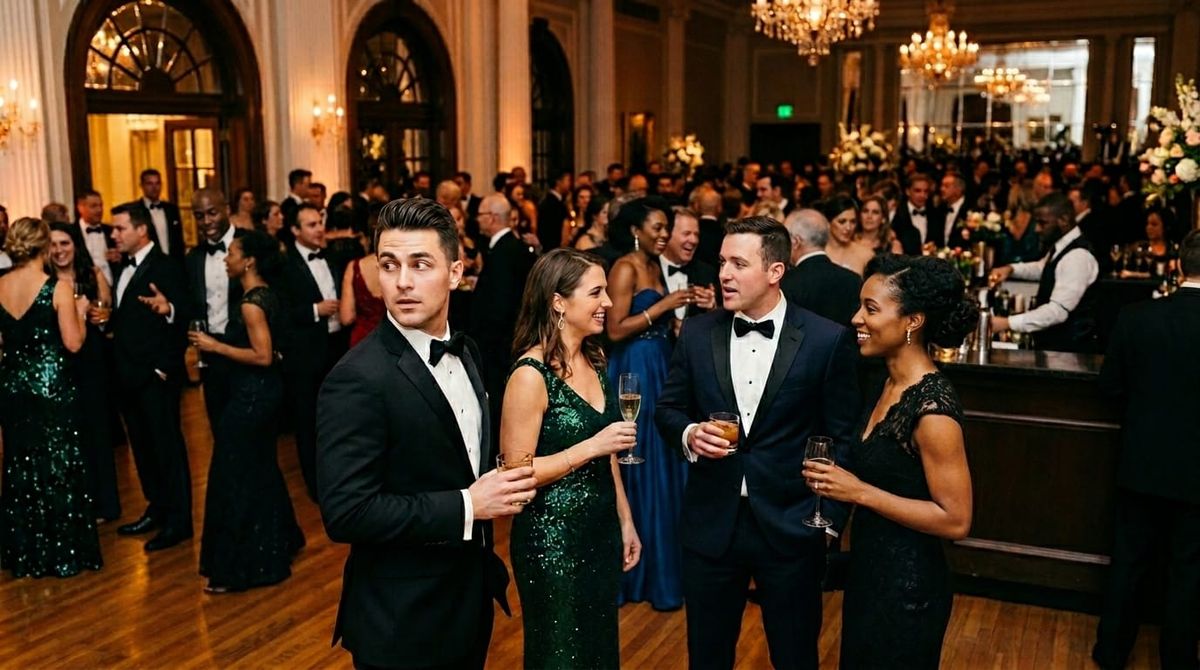
Whenever I am at a cocktail party, I always find it awkward to leave a small clique of attendees. I know the purpose is to circulate or, as the technocrats label it, “mingle dynamics.” Everyone else is aware of this also; otherwise, the hostess will observe the dreaded bane of cocktail parties: clumping. If guests fail to circulate and stay in the same groups all night long, the event’s social vitality inevitably stalls.
“Can I get you a drink?”—my only release tactic—only goes so far. So, in order to improve my awkward conversational disengagements, I decided to find as many techniques as possible so I could excuse myself with A-list celebrity grace. With such a toolkit in hand, conversations are confidently navigated from one to another with ease.
So, where to begin? First, let’s reframe the concept. As any diplomat will tell you, it is not rude to withdraw from a conversation. No, a guest is performing a “benevolent release,” the circulatory engine of the party. Otherwise, one becomes an anchor, impeding the main purpose of the gathering. By reducing the “social velocity” of the gathering, fewer ideas and experiences are exchanged.
The first step of a graceful exit is setting up the preparatory body language. While you are talking, subtly orient your feet toward where you want to go next, but keep your torso positioned toward the person you are talking to. This provides a clearly defined exit when concluding remarks are made. If you are seated, lean forward with your hands on the arms of the chair. This gives the impression you are about to leave, which you are. While doing this, it helps to have shorter replies such as “right” and “I see what you mean,” indicating the information exchange is in its concluding phase.
Additionally, scanning the room is an important prelude to leaving a group. This, however, must be done with great care. Looking over the head of the person who is talking to you signals extreme rudeness. It’s equivalent to saying, “Carry on, I’m just looking for someone else to talk to who is way more interesting than you.” To avoid that, first make sure the person with whom you are engaged in a conversation has paused. Then, when you subtly scan the room, make it absolutely clear you are engaged in a pre-planned goal, such as “I promised my wife I’d talk to her friend” or “I need to catch Stan before he leaves.” This makes it clear you were not hunting for better options but acting on something already in the works.
Honesty, in many cases, is the best policy. So, the best way to make your verbal exit is to be straightforward. After all, everyone is there to mingle, so why try and hide that fact when saying goodbye? Here are some variants to consider:
• Everyone gets a benevolent release!
Not only do you want to mingle, but the people to whom you are talking do too: “It’s been great talking to you, but I’m sure you have a lot of people to catch up with. And I promised Sally I’d help her with the drinks.”
• See you later.
Saying goodbye at a cocktail party is not such a big deal since you’ll still be within a stone’s throw: “I’m going to go mingle around a bit, but I’ve truly enjoyed our talk. I’m sure I’ll see you later!”
• Let’s do lunch.
Maybe you’ll see the person you are speaking with at a later date, so work that in: "It sounds like you have a lot going on with your project. Here’s my card so we can meet later this week.”
• So much networking, so little time.
Fall on your sword so your conversational partner can thrive: “I don't want to monopolize all your time. I know you have many friends to catch up with here.”
As for offering to get someone a drink, if done right, it’s not the dead end I’ve been led to believe. In fact, there are surprising variations to this tactic which I will discuss next time. Cheers!