The Infuriating Hubris of the "Right Side of History"
There are many bromides that annoy me, but stating that one “is on the right side of history” is by far the most grating. Declaring that one is on the right side of history is often used as a bullying tactic, a sweeping invalidation of a different point of view. Upon witnessing this pronouncement made with so much confidence, I am momentarily taken in, thinking the future historical timeline proposed by my adversary, neatly bordered by “sides,” is real. Yet it’s nothing but conjecture by a person who is as trapped in the present as much as I am.
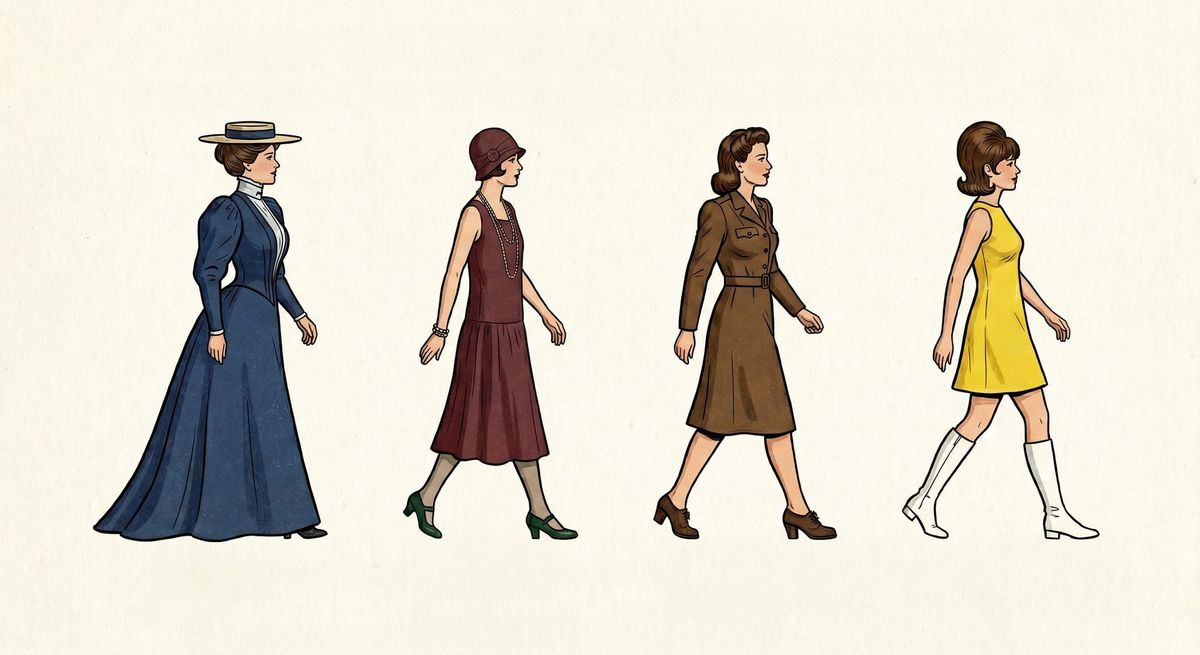
This overconfidence stems from a misunderstanding of how change actually happens. The future is not just a continuation of what has happened, but the addition of sudden pivots and reversals. Take, for example, the Star Trek producers who were charged with the unenviable task of predicting the future. As they designed the official female Starfleet uniform, they took note of the evolution of women’s fashion. In 1900, a dress’s hemline was to the floor. As the century progressed, the hemline rose until it was the length of the miniskirt in the mid-1960s, the time Star Trek was filmed. It’s possible the producers thought that this was the ultimate goal of the women’s hemline. Why, it was inconceivable that the hemline would thwart progress and retreat downward again! The hemline, after its arduous journey upward, would never retreat and would stay at that length for the next 400 years. True to historical trends, and with no thought to increasing audience interest by exposing more of the female form, the uniforms with short skirts appeared.
Imagine their surprise if you told them that when 1970s fashion rolled around, the fashion industry would declare the miniskirt "dead" and introduce the midi skirt (which hit mid-calf) and the maxi dress (ankle-length). Further compounding their surprise, you then tell them a counter-movement embraced an idealized, old-fashioned look often called the "Granny look" or "Prairie style,” complete with high collars, ruffles, lace trims, and long sleeves. The future of hemlines would barely survive the decade, not to mention 400 years. So much for predicting the future.
Of course, I’m having a little fun with the Star Trek producers. I’m sure in designing their futuristic show they were not ideologically invested in how the future played out. But those who believe in the "right side of history" are not just playing with hemlines; they are trying to force the hand of human destiny. Their certainty about tomorrow isn't from superior foresight, but a desperate psychological necessity.
As I have already chronicled, many people are very concerned about being left out of the group. The Spiral of Silence, a sociological theory by Elisabeth Noelle-Neumann, states that individuals have a deep fear of isolation. Because of this, they are constantly looking around to see which opinions are gaining ground and which are not. If they feel their view is losing, they fall silent. Sociologist Charles Cooley adds to this by arguing that we form our self-concept based on how we think others perceive us.
So if present reputation is such a driving concern, what about the fear of the judgment of posterity? The insistence on being on the right side of history solves this problem. It is used by people who are secretly terrified of being left behind. It is a desperate act to ensure that the imagined future crowd is cheering for them, because the thought of being judged negatively by posterity creates the same anxiety as being booed by a crowd today. By claiming alignment with the "future herd," they protect themselves from the vulnerability of being isolated right now. The irony is, as mentioned above, that the phrase is often uttered with great confidence, but it only reveals a deep-seated fear of social exile.