The Final Three
(This is the last part of a four-part series. See part 1, part 2 and part 3 for background.)
Finally, the baddest of the bad of 1926:
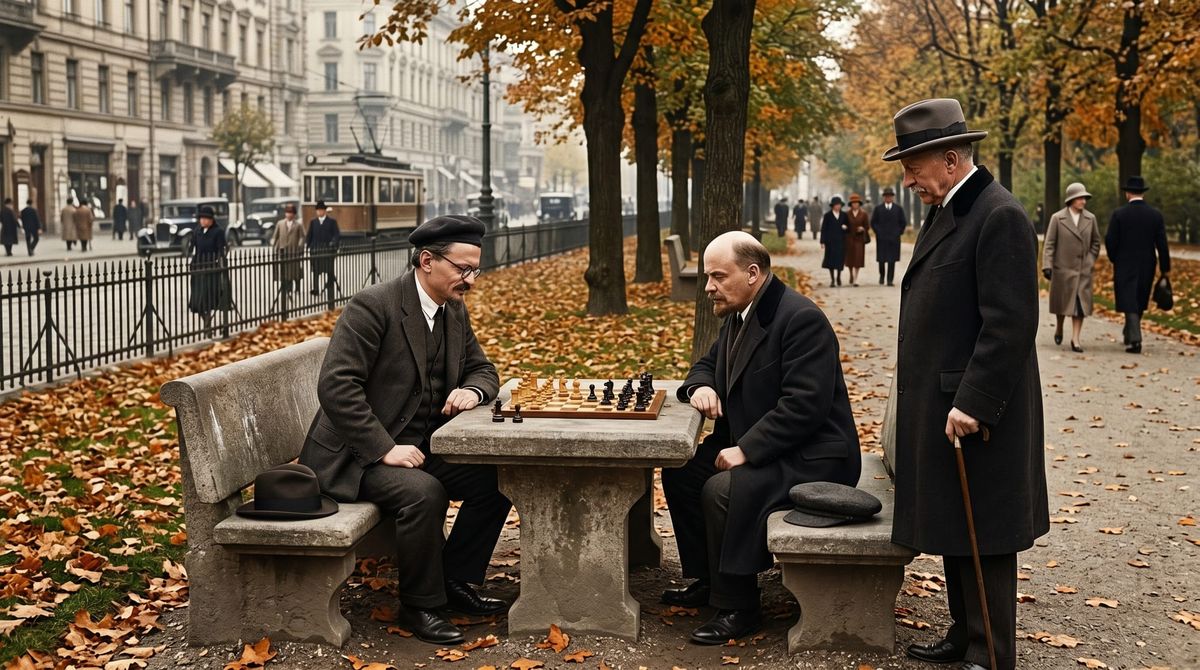
3. Leon Trotsky
Although not unknown, Leon Trotsky has fallen off today’s radar. Most likely, it was because he was assassinated by a Soviet agent in Mexico and formally forgotten by the Soviet Union (and even airbrushed from Soviet-era photographs). Even though he was ousted from the Politburo in October, he still was seen as quite the threat, especially to capitalism. Trotsky was the strategic man behind the revolution, a danger to everyone’s way of life, and the man who made bad things happen. An unwavering communist, he not only overturned Russia's society but was fomenting violent revolutions across the globe, an image strengthened by his blistering speeches given from the Central Committee.
Critics of Trotsky were scathing. Economist John Maynard Keynes published a highly critical review of Trotsky's work, Where is Britain Going?, dismissing his ideology, which he saw as rooted in "terror and persecution." As the UK General Strike unfolded in May 1926, Winston Churchill utilized Trotsky as a cautionary example to alarm the British public. He warned that Trotsky's doctrine of "Permanent Revolution" was not isolated to the Soviet Union and could arrive on the shores of Great Britain to overthrow the government.
2. Kaiser Wilhelm II
Sometimes timing is everything, and this list is no exception. If this list were about how evil was perceived in 1920, the Kaiser would be "the winner" at number one. But six years later, due to the public's notorious short attention span, other events have captured their fears, and Kaiser Wilhelm II fell to number two. Still, this is noteworthy since there is plenty of opprobrium to go around.
In 1926, the tortuous analyses of how World War One began were not written yet. But in this era, the answer was simple: it was all Kaiser Wilhelm II's fault. He was personally blamed for the atrocities committed during the invasion of Belgium, unrestricted submarine warfare that sank civilian vessels, and, maybe worst of all, the use of poison gas on the Western Front. The anger was so palpable that Article 227 of the Treaty of Versailles explicitly indicted him for a "supreme offence against international morality and the sanctity of treaties," demanding his extradition for a war crimes tribunal.
Emil Ludwig’s biography, The Last of the Kaisers, described him as a megalomaniac whose personality issues caused the deaths of millions. The Kaiser himself tried to present his side of the story in his memoir, My Early Life, but it was universally panned by critics, who noted how unaware Wilhelm was of his transgressions. Even Queen Victoria weighed in; her recently published letters stated that her grandson was a "hot-headed, conceited, and wrong-headed young man." As critics have noted, no amount of damage control could change the fact that his perceived vanity had set the stage for a continent's ruin.
1. Lenin
Lenin died in 1924, but by 1926, he, ironically, was more famous than ever. While not a big part of the day-to-day news cycle, he became an ever-present symbol of tyranny that haunted the Anglosphere. While Wilhelm was consigned to retirement, Lenin’s destructive influence was ongoing. By now, people were resigned to the fact that it was permanent, not a temporary disturbance that would pass after the conclusion of the Great War. Lenin represented a threat to capitalism and religion, a fact that played on the public's sense of urgency. In addition, the traditional family unit appeared under siege as the state began recognizing only secular marriages, facilitating easy divorce, and implementing state-led education that contradicted parental teachings.
At this time, Vladimir Lenin shifted toward that of a tyrant as his "secret testament" was published in the New York Times. This view was reinforced by the American Federation of Labor, which officially rejected the Soviet government by denouncing Lenin’s legacy as an "evil autocracy" that destroyed individual freedom. The emerging reports of the Solovetsky Islands labor camps didn’t help either. They compared the Gulag system to Lenin’s original philosophy of class extermination. Lenin’s name was now considered synonymous with modern oppression and terror.
So that’s it: the top ten nefarious figures of 1926. But what about 1826? Without Lenin, Trotsky, and Wilhelm, who would you choose? Probably one of them would be Maximilien de Robespierre, the architect of the Reign of Terror. However, I’ll refrain from continuing. Evil has been present since the flood (and before it, too!), and recursively falling back is an endless regression. As I’ve shown, the names change, but the ethos doesn’t.