The "Wonders" of Creative Destruction
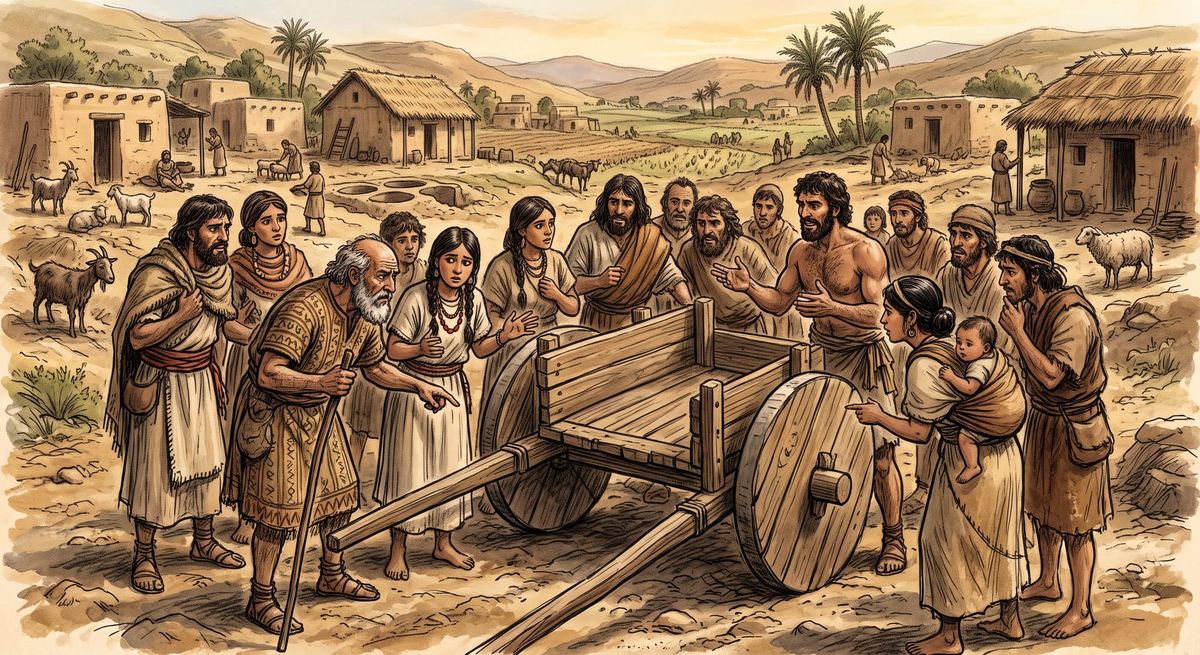
In my book “Immortality Is Really Forever,” an undeveloped society is just barely in the agrarian stage. The main character, the immortal Mathew Sella, introduces a cart to shift the burden of transport off human backs, thereby ruining the livelihood of "carriers," those hired to carry cargo:
Why hire someone to carry things when you can have your very own cart to transport whatever whenever? All I can say is welcome, my barely civilized friends, to the wonders of creative destruction.
I always thought the expression “creative destruction” was of recent origin, a buzzword coined during the dot-com boom/bust of the late 1990s. It was bandied about by such luminaries as Andy Grove, CEO of Intel, New York Times columnist Thomas Friedman, and Secretary of the Treasury Lawrence Summers. As Federal Reserve Chairman Alan Greenspan characterized it:
The evident acceleration of the process of 'creative destruction,' which has accompanied these expanding opportunities and which has been reflected in the shifting of capital from failing technologies into those technologies at the cutting edge, has been remarkable.
However, the expression “creative destruction” is of considerably older vintage and was first used back in 1942 by the Austrian economist Joseph Schumpeter in his book “Capitalism, Socialism and Democracy.” As Mr. Schumpeter put it, creative destruction is the "process of industrial mutation that incessantly revolutionizes the economic structure from within, incessantly destroying the old one, incessantly creating a new one". Or more succinctly, it’s when AI can do the work in five minutes that took you all day to do.
AI productivity and direct competition with human labor is a hot topic. Even though there is some obvious short-term disruption, there are those predicting much more pain to come and those who believe that AI will bring job growth and wage increases. I am on record saying that “predicting the future is a fool's game,” so I don’t know which way the pendulum will swing. What I do know is that we have been through this before—a lot.
Even thousands of years ago, the shift from nomadic foraging to farming, or the invention of the wheel that rendered manual hauling obsolete, required getting rid of old practices, skill sets, and social customs to make room for economic growth.
Creative destruction was most visible during the Industrial Revolution of the 18th and 19th centuries. Mechanized looms replaced the centuries-old guild system of hand-weavers, replacing home industries with steam-powered factories. Also, the rapid adoption of the steam engine and railway network ruined river-barge transport and stagecoaches. The electric light extinguished (pun intended!) the whale oil and gas lamp industries.
And just like today with the negative press about AI and protests outside server farms, economic anxiety spurred initial resistance and widespread fear of permanent job loss. Short-term disruption caused economic pain, yet the resulting efficiencies of productivity raised living standards far beyond what preceding ways could deliver. Innovative kinds of labor came into being to run the new economy. Over the course of millennia, we traded familiar modes of work for greater technologies, showing that the disruption of the past becomes the foundation of the present.
Unfortunately, if one’s livelihood is destroyed, participation in the “creative” part of creative destruction doesn’t happen. Paradigm shifts, as the analysts like to sugarcoat it, are messy and very disheartening. And even recalling that humanity has been through this before is not very comforting. But it is what it is. AI is too powerful a tool for our society to forget, so it’s not going anywhere. So while we cannot turn back the pace of innovation, we still have the choice on how to personally confront it.