TJ's Wheel Cipher
An exploration of Thomas Jefferson’s wheel cipher, an ingenious 18th-century cryptographic invention utilizing 36 rotating wooden disks on a spindle. This essay breaks down the mechanics of early American diplomatic encryption and Enlightenment-era technology.
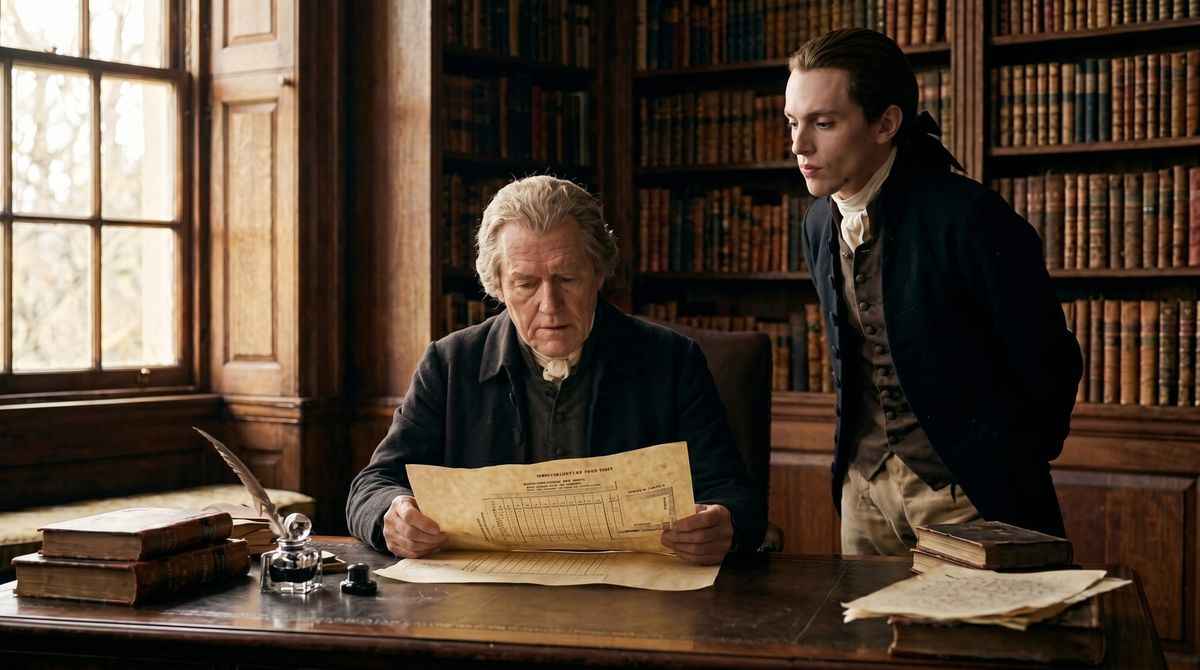
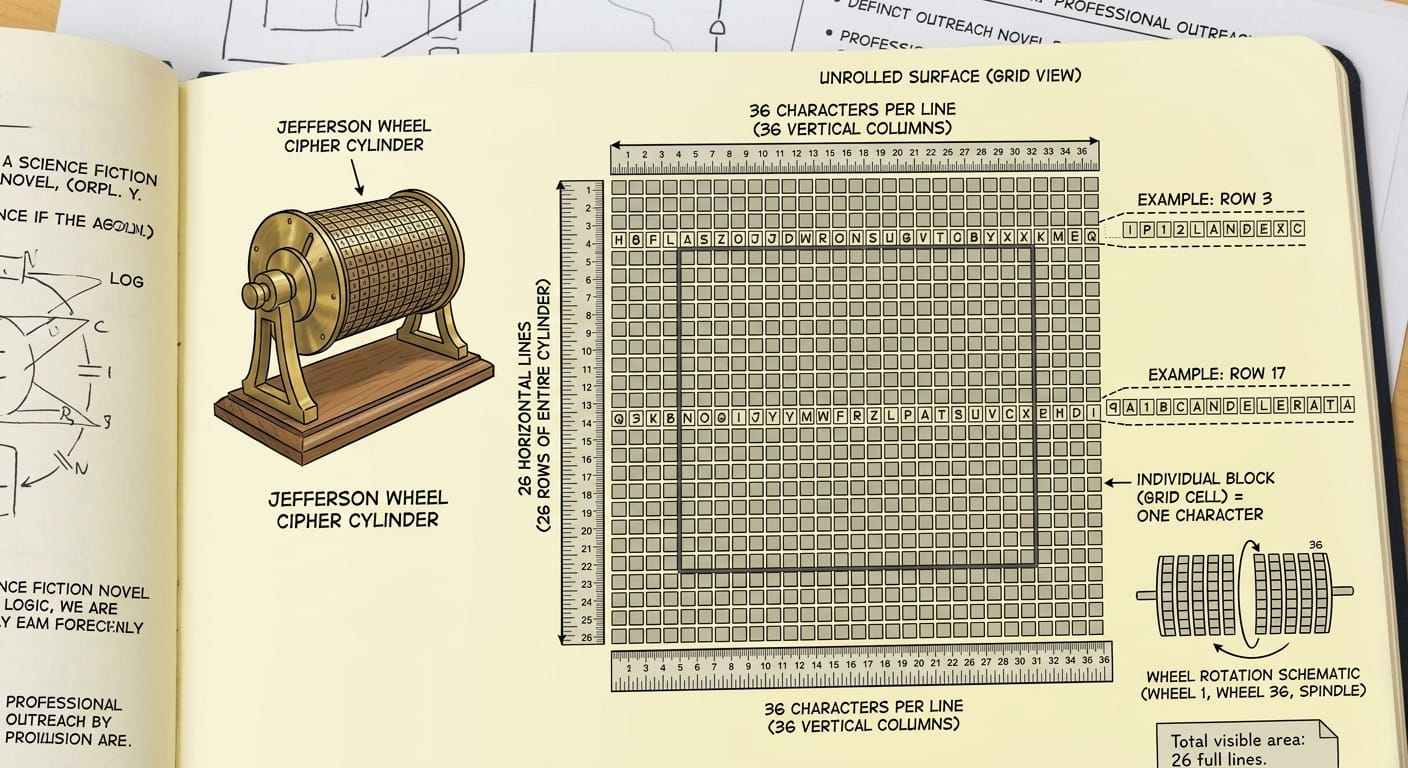
Thomas Jefferson eyed the plans of his new invention with fatherly pride. It was a wheel cipher, one of two identical instruments. The device was a cylinder composed of 36 rotating wooden disks threaded onto a central spindle. Because each disk had the 26 letters of the alphabet stamped around its edge, the cylinder displayed 26 horizontal rows, allowing for a message up to 36 characters long. To send an encrypted dispatch, Jefferson would rotate the disks to spell out his plain text along one row. He would then look at any of the other 25 jumbled rows on the cylinder, write down that scrambled sequence, and send it to the recipient. Because the receiver had the second, identically ordered cylinder, he only had to align the scrambled text on one row, spin the cylinder, and look for the single remaining row that revealed intelligible words.
With Jefferson in his office was Thaddeus, the local clockmaker. He was a young man of about twenty-four, pale, thin, and well acquainted with the arrogance of youth. He didn’t wear a wig, but carefully gathered his natural hair into a sleek queue tied with a black ribbon, as was the fashion of the day. Jefferson figured the clockmaker, a practitioner dealing with the cutting-edge technology of the day, would be someone he could bounce some ideas off of. He couldn’t have been more wrong.
“This draft looks good, Mr. Jefferson, pretty good,” Thaddeus said. “But there are things that could make it better.” Thaddeus wore an expression of faux concern. “For example, you only use the 26 letters of the alphabet. You should do something more.”
“Oh, and what might that be?” Jefferson was slightly intrigued, but guarded.
“You don’t have any non-alphanumeric characters.”
Jefferson was not familiar with this term. In fact, no one was, since the term wouldn’t be coined until 1912. But somehow Thaddeus knew.
“Non-alph…”
“Yes, non-alphanumeric,” Thaddeus pronounced the term with exaggerated clarity, showing his deep intellectual familiarity with it.
“And what exactly are these, these…”
“They are symbols such as the asterisk, ampersand, and parentheses. You don’t have them in your cipher.”
“And…”
“Let's say you have a code eight letters long, like a password you would have used, as Governor, to enter a military garrison. Using only the 26 letters found in the cipher, you only have 200 billion iterations to work through.”
“That sounds like enough to me.”
“No, no, no!” objected Thaddeus. “You need more, much more! Hence the need for non-alphanumeric characters!” Thaddeus loved saying this.
“I don’t see what…”
“You know, like the ampersand,” interrupted Thaddeus. “Did you know that it was invented around 63 BC by Marcus Tullius Tiro, a slave and personal secretary to the famous Roman orator Cicero? It’s the blending together of the letters in the Latin word for 'and': et. If you look at an italic ampersand (&), sometimes you can even see the 'e' and 't' joined together!”
Thaddeus looked at Jefferson with a big smile, hoping to be rewarded for his incredible, pre-wiki knowledge. The response was a blank look. Jefferson had just finished scrupulously drafting his plans for his cipher, and now this young man wanted ampersands in it?
“Perhaps ampersands won’t be necessary…”
“My God, man, a password should be an ugly thing!” exclaimed Thaddeus. “Hard to remember! Painful to write! Ugly to see! That’s what makes a password a real password!”
Thaddeus’s enthusiasm was infectious—not to Thomas Jefferson, but as a contagion destined to leap forward through centuries of time and infect the yet-to-be-born computer nerds of our own era.
Jefferson, although a talented statesman, still was one who hated confrontations, especially one-on-one in an informal setting. But even he had his limits.
“Thaddeus?”
“Yes.”
“You know, there is a quite well-developed colony on the subcontinent.”
“Subcontinent?”
“Yes, specifically India,” Jefferson said. “Perhaps you might find much to do there with your clockmaking.”
“That’s called practicing horology.” Thaddeus was always sure to preserve the prestige of his profession.
“Yes, that,” Jefferson said. “You could operate in India, away from the hurly-burly of our chaotic new nation. If I need any advice from you, we could communicate with letters. You would be out of the fray, and yet my source of information.”
Thaddeus was puzzled. Why would Jefferson propose this, considering he was doing so much to make sure that the world was as smart as he was? But seeing the older man adjust his papers, a cue that the conversation had reached its limits, Thaddeus realized his mentoring for the day was finished. Hence, he took leave of the future president.
Whether Thaddeus ever made it to India remains a mystery. But if he did, he achieved immortality not through his work, but by becoming the world's very first tech-support outsource, banished to the other side of the globe by a statesman who simply wanted to compose his own thoughts without an uppercase letter, a number, and an obligatory 63 BC ampersand.