Truth's Messy Scaffolding
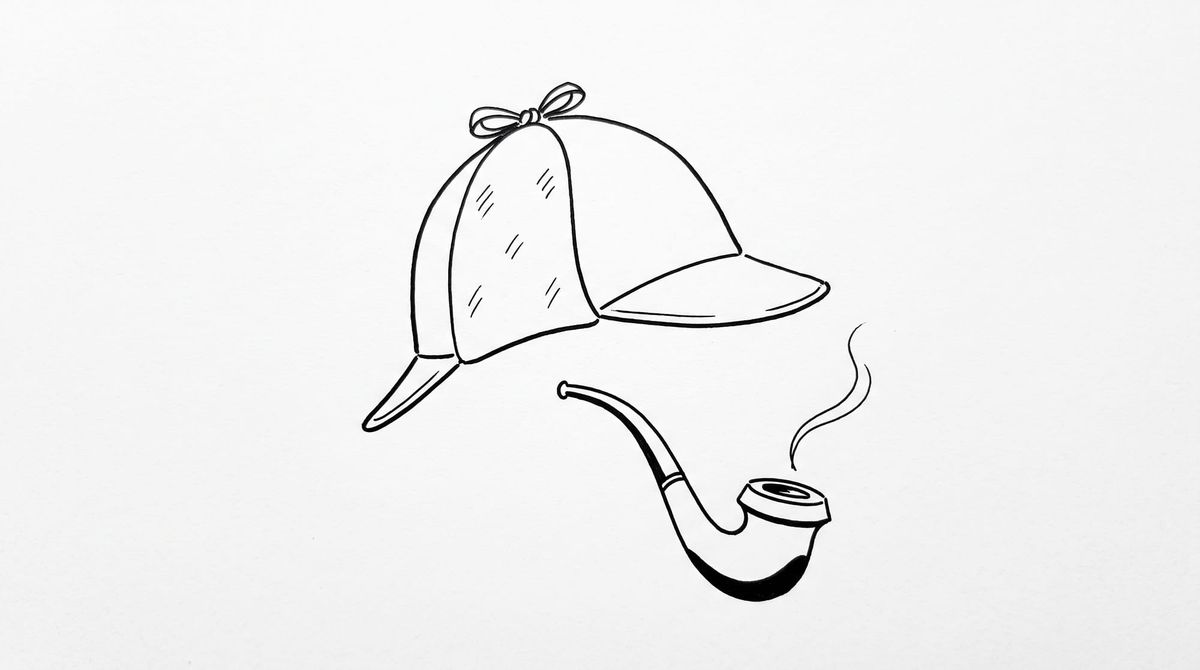
Okay, you’re at a party and someone says to you, "You know, Sherlock Holmes didn’t use deduction; he used induction."
You smile courteously because you already know that and politely dismiss it as being overly pedantic. But since you are not at a cocktail party dodging blowhards and are reading this instead, I invite you to take a closer look at induction.
The first tip-off to me that induction carried more weight than I gave it credit for was the index of Mortimer Adler’s Syntopicon. Briefly, it is a collection of essays featuring 102 key ideas addressed by Western writers and philosophers of the past (e.g., logic, truth, justice). On the list, I saw "induction," but there was no listing for deduction. I wondered why a comprehensive catalog of topics central to the human condition favored induction over deduction, especially since deduction seems by far the most familiar. The implied answer is that deductions are impossible to perform without first performing inductions.
The most famous deduction is the classic syllogism: "All men are mortal; Socrates is a man; therefore, Socrates is mortal." You have two premises: all men are mortal, and Socrates is a man. But to accept those premises, you had to rely on a lifetime of inductions: that Socrates was an actual biological man, and that no human in history has lived forever. Induction, then, is figuring out a general rule by observing lots of specific examples of a phenomenon. For example, the sun rises in the east every day, so one induces that the sun will rise again tomorrow. Induction does not guarantee that any pattern will hold; it just asserts that it is probable.
To further complicate matters is the concept of abduction, introduced by the American philosopher Charles Sanders Peirce. Abduction is the process of finding the best explanatory hypothesis for an unanticipated set of observations. For example, you turn the key in your car. The dashboard lights flicker weakly, the engine clicks rapidly without turning over, and the clock resets to 12:00. Because past induction has taught you that these symptoms occur when a vehicle lacks sufficient electrical power, you conclude through abduction that either the battery is dead or the terminal connection is loose. Incidentally, you could have told your cocktail party conversation partner that Sherlock Holmes actually used abduction, but that would have been ungenerous.
It is disorienting, to say the least, that virtually everything we know is the result of induction and abduction. Just watching how the world works and drawing casual conclusions seems to be a recipe for disaster. And many times it is! We all know the crazy conclusions humans have made throughout history, not to mention the ones made by people we spoke to just last Tuesday. Francis Bacon was cognizant of this. In his day, he broadened the definition of induction to encompass both inductive generalization and what we now recognize as abduction: the generation of explanatory hypotheses. He heavily criticized "induction by simple enumeration" as a puerile method that can be overturned by a single unforeseen exception. He maintained that one’s experience must be supplemented by experimentation designed to smoke out "negative instances."
So how do we go beyond this? Any pattern we figure out could easily have a major exception that we never see. There is testimony from other people that may guide us. Humans have the gift of metacognition, reevaluating thoughts we have accumulated over time, so perhaps that helps. Our brain keeps track of probable future events, which is also a help. But as I think about all these tools, each one could fail: the information from other people may be wrong, one’s logic may be defective, or the brain may become stubborn and calculate poor probable outcomes. If all our tools are inherently flawed, why does the world work as well as it does?
And yet, human beings do seem to stumble somewhat through existence. After observing the abyss of human fallibility where contemporaries believe ridiculous things such as a flat earth, it is hard to make peace with the miracle that airplanes stay in the air, medicines cure disease, and we generally manage to navigate our lives without driving off a cliff. All of this is built on the messy scaffolding of induction, far away from the pristine certainties of deduction. And maybe that is ultimately why the word "deduction" is not in the Syntopicon; pristine certainty is a luxury of mathematics, while navigating uncertainty through induction is the true human condition.