Unsolicited Advice On Unsolicited Advice
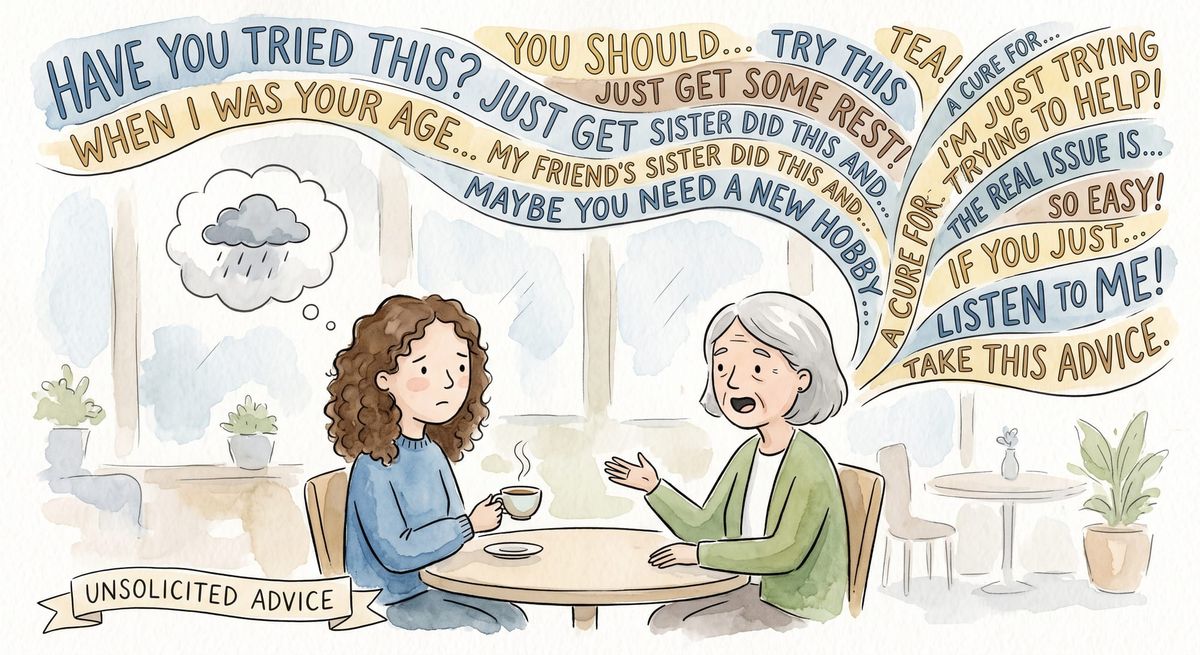
I have a special gift: I can read minds. Not only that, but in the right situation, I can sense the hopes and fears of the person I’m talking to, feelings often hidden from view. Yet, these feelings are absolutely clear to me. And the best part is that I can tell you my secret so you can read minds, too. It’s really pretty simple. Ready?
It’s listening to unsolicited advice.
We’ve all been there. We are with our relatives or friends, involved in some conversation or other. In that conversation, you mention some future plans, whether about your career or your personal life. An individual then begins giving you advice that you didn’t ask for. Implied in the advice is that the plans you just laid out are insufficient in some way. He goes on to tell you that instead of doing what you were planning to do, you should do something else. He is certain because, since he has all this advice, he must have the experience you lack; that is the implied conceit of unsolicited advice. The recipient of the advice is not very happy with this. The advice contradicts her plan without considering its complexities.
And this is where mind reading comes into play. The advice-giver, through his advice, is revealing his internal anxieties, deep-seated fears, and aspirational hopes. By giving the advice, his desire to control these emotions is projected onto another person. And there it is: the fears and anxieties, hopes and dreams, normally hidden deep in the recesses of the advice-giver’s mind, are laid out right in front of you. And yes, it is annoying to have someone tell you things you have already worked out, but it is also an opportunity. Just put the annoyance aside and listen, because it provides an opening to learn something about that person normally hidden from view.
So why is unsolicited advice so annoying? Frankly, it’s intrusive. The advice-giver is essentially saying, “You are not handling this right, and I know better than you do about your own life.” Individuals desire autonomy; people want to make their own decisions without unnecessary obstructions and distractions. It is an imposition to sit through someone attempting to take that power away. It’s not the information being offered that is the problem, but the presumption.
Yet the advice-giver also has his own emotional burdens to manage. During a conversation, for example, about plans to start a business, the advice-giver hears all the steps and procedures required and accumulates anxiety of his own. To release this anxiety, he decides to offer advice. The illusion is that giving advice makes a purely hypothetical situation manageable and predictable, thereby easing his anxiety. And, of course, the advice-giver falls for another illusion: that if his prescriptions are followed, everything will work out fine.
Frequent unsolicited advice-givers often exhibit traits associated with the "alpha" personality. Such individuals typically view situations through a black-and-white lens, unable to tolerate ambiguity or different viewpoints. This rigidity is often accompanied by an overestimation of competence; the advice-giver believes that his advice is optimal and that everything would function more smoothly if he were responsible for all decision-making. Then there are those who are truly altruistic. Instead of trying to control things, they are more interested in relieving the distress of the advice recipient rather than running the show.
So there you have it: Mind Reading 101. You can now delve into the psyche of the advice-giver, learning much more than the "helpful" tips he is bestowing upon you. And remember, if you feel the impulse to give unsolicited advice in the future, you will recognize that you may not be offering a solution to someone else's problem, but are instead trying to soothe your own anxiety.