Washington's Surprising Challenge
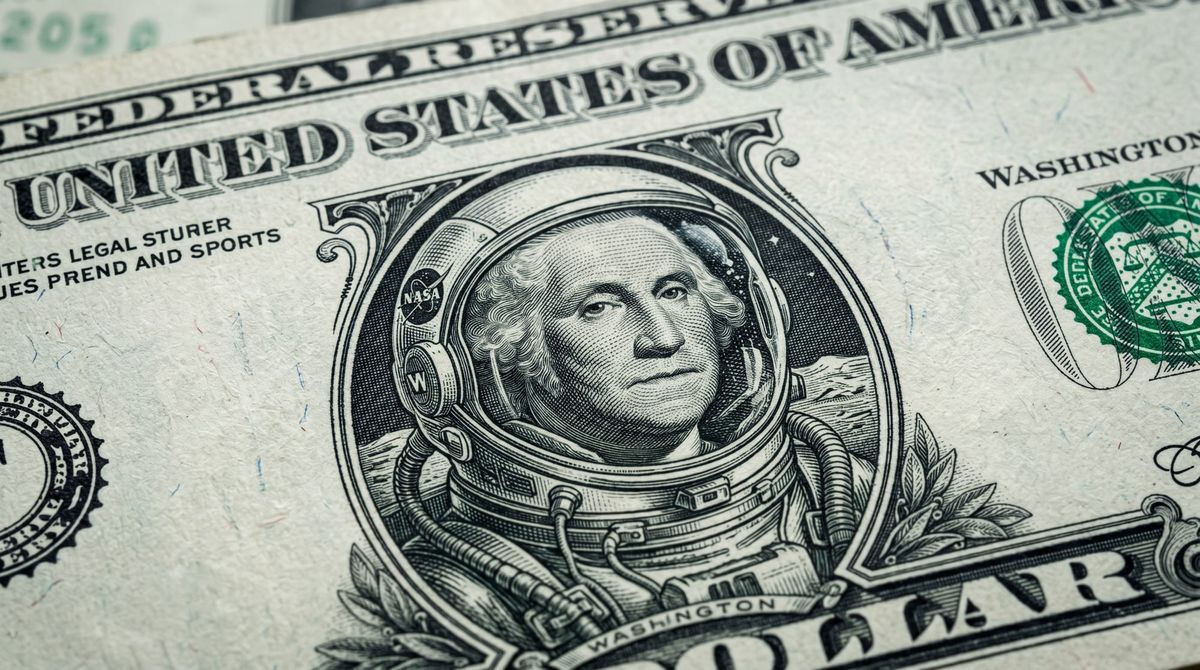
George Washington’s inaugural address was quite the affair. There were thousands of people packed along Wall and Broad streets in New York City. Quipping that he “felt like a culprit going to his execution,” the future first president was visibly nervous. He had great things to say and he knew it. About fifteen minutes into the speech, he spoke the following:
Having thus imparted to you my sentiments as they have been awakened by the occasion which brings us together, I shall take my present leave. But before I do, I believe that this nation should commit itself to achieving the goal by 1969, 180 years from now, of landing a man on the moon and returning him safely to the earth.
Within the present epoch, no singular enterprise directed toward the Heavens shall more profoundly strike the mind of Man with wonder, nor be of greater weight for the eventual discovery of the Firmament; yet let it be known, that no endeavor shall prove so arduous to the spirit, nor so great a burden upon the public Treasury to achieve.
Well, this was quite something and caused quite a stir among the crowd, not the least to Robert Livingston. Still holding the Bible that he used to swear in the new president, he almost fell off the podium onto the bass drum below. Livingston was the most scientifically learned person attending the inauguration. In 1791, he founded the Society for the Promotion of Agriculture, Arts, and Manufactures. Furthermore, he became a key patron of Robert Fulton, providing the technical and financial support necessary to launch the age of the steamboat. Of all people, Livingston would know the difficulties involved. I’m sure he wished that Ben Franklin was there to help, but unfortunately, the world’s most famous scientist was ill with a kidney ailment and would die one year later.
But since the now-president Washington was revered by so many, they thought they had better get cracking. After all, a man on the moon is quite the enterprise and 180 years will be just enough time to get it done under the wire. So Livingston had a proposal drawn up based on what was known at the time.
First, a “Great Celestial Carriage” must be constructed. It will be fashioned of reinforced copper and sealed with lead and pitch to withstand the “unforgiving void” of space. To sustain the travelers, the vessel will be supplied with Monsieur Lavoisier’s recently discovered oxygen, the very substance that sustains the life-giving force. This carriage will be propelled into the “firmament” by twenty tons of gunpowder, fired from an iron cannon two miles in length and buried deep within the Blue Ridge Mountains. As telescopic observations have put to rest the myth of lunar oceans, potable soil must be carried to the Moon. There, within glass greenhouses, plants will sprout to provide both sustenance and a renewed supply of air.
So the proposal was sent to the White House where it was filed away. When the British burned Washington, D.C. in 1814, the proposal also perished. It was not missed because the scientific community decided it was absolutely, completely, beyond impossible, a flight of fancy of a great man. After all, the beloved Washington could have been king. And a man who declines to be king can easily be forgiven for wanting to reach for the stars.
So why do this alternate history? It shows that sometimes things that seem impossible will not be impossible in later eras. Future scientific discoveries aren’t just building one invention upon another, although this is essential, but new discoveries require changes in conception. Old paradigms must be discarded so that new ones can take their place. For example, in 1789, Maxwell’s field theory was unknown; scientists believed space was absolutely empty, making it inconceivable to contact astronauts during a flight. However, once the paradigm of “empty space” was overturned, Maxwell’s new paradigm of fields made radio communication possible, a feat that would have seemed like magic to an 18th-century scientist.
Then there is the concept of thrust. It was believed that the only way to propel something was an initial burst of force. This was considered an unavoidable limitation based on what Newton discovered. Yet we know through the work of Konstantin Tsiolkovsky and Robert Goddard about the concept of constant acceleration. They discovered it’s possible for a rocket to push against its own exhaust, thus making acceleration more gradual, and parenthetically survivable. If we had launched 18th-century astronauts into the aforementioned giant cannon, they and their powdered wigs would have been crushed to death.
Perhaps the most significant paradigm shift of this millennium was the rise of the Transformer, as I chronicled before. By setting aside traditional Natural Language Processing in favor of the Transformer architecture, AI has advanced by leaps and bounds. In fact, if I had been shown Gemini twenty years ago, I would have considered it as much a feat of “magic” as an 18th-century scientist would have found radio communication. So the lesson is, don’t be afraid to think outside the box. Sometimes you won’t believe what you come up with.