Marooned in the Wrong Era

It is a cruel twist of fate to be born at the wrong time. Some individuals are confronted with inspirations that are far ahead of their era (see my satire on Washington's Dream). One well-known example is Charles Babbage (1791–1871). He observed that calculating tables for naval navigation, astronomy, and artillery, tasks performed by human clerks known as "computers,” was a tedious enterprise that exhausted the workers. More seriously, inevitable human errors could cause shipwrecks. He longed for a mechanical means to perform these calculations. He eventually designed the mechanical forerunner of the modern computer, but trapped in the nineteenth century, he lacked the precision manufacturing and funding to build a working implementation.
A century later, Mortimer Adler suffered the same kind of frustration. Although not as well known as Babbage, he had insights that could not be adequately realized in the mid-twentieth century. Adler envisioned the capability of querying the entirety of Western civilization by meaning rather than mere keywords, intuitively putting together the building blocks of AI decades before computers could even attempt it
Synthesizing broad topics was not a novel concept. As Adler knew from his background in jurisprudence, lawyers preparing for a case did not read every individual decision from scratch. Instead, to avoid being overwhelmed by reams of case law, they relied on legal digests and encyclopedias that organized principles into practical reference works. Adler’s insight was that the same indexing method could be applied to the Great Conversation of the humanities. This led to the creation of the Syntopicon, a monumental two-volume subject index designed to guide readers through the 54-volume Great Books of the Western World by cataloging 102 fundamental ideas. As Adler noted of the project's ambition, what Corpus Juris did for the legal profession, the Syntopicon would do for the general reader.
Mortimer Adler was given an initial budget of $60,000 from William Benton, estimating the project would last six months. Restricted by a computer-challenged era, he needed to employ human "computers," much like naval officials had to do in the nineteenth century. Instead of droning away in a sea of calculations, they foraged stacks of books looking for trends of thought through the millennia. Once information was found, they wrote it on index cards. Later came the enormous task of combining the more than 3,000 specific topics and over 164,000 page references into something cogent, which would evolve into the 102 essays Professor Adler wrote. The project was severely underestimated in cost and labor; it ballooned to 100 workers (a young Saul Bellow was among them), two million dollars, and ten years to complete.
It was during this process that Adler learned the difference between mere word search (today’s keyword-driven search engines) and semantics (our era’s artificial intelligence). The first attempt was the Greek index. He found that over the centuries of ancient Greek civilization, terms changed in meaning. For example, arete began in Homeric poetry as a term for physical prowess and battlefield valor, but centuries later in the dialogues of Plato and the treatises of Aristotle, it had evolved into an internal quality of moral virtue and civic justice. It was clear he would need an index organized by concepts rather than a mere catalog of words.
Here, Adler pioneered the very AI concept we take for granted: filing by meaning, not just keywords. When an instance of a concept appeared, it was collated with similar ideas, allowing the team to refine the overarching concepts before starting the final index. The result was 102 Great Ideas divided into nearly 3,000 subordinate topics, the very kind organization that modern AI is designed to build.
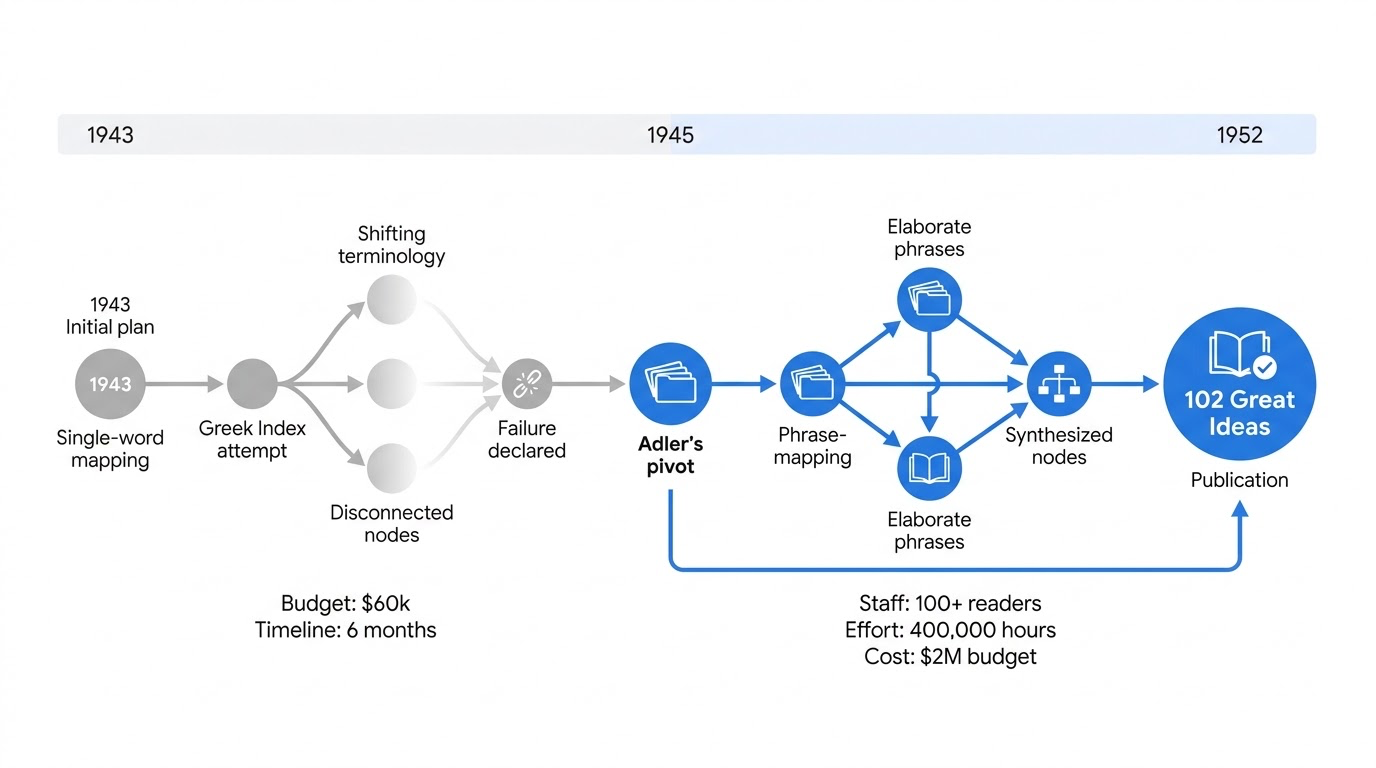
Adler approached artificial intelligence from the top down, categorizing concepts through direct human understanding. Modern AI, on the other hand, reaches the same destination from the bottom up, using billions of text tokens to map relationships and derive meaning. In essence, he was doing manually in 1945 what the software industry could only conceptualize in the 1980s (Cyc), search mechanically in the 2000s (LDA), and finally execute natively with deep learning in the late 2010s.
Would Babbage and Adler find our computers and AI an absolute marvel if they could see them today? I hope so. Babbage would see naval coordinates instantly materialize via our networks and GPS satellites. Adler would be free to discover yet deeper meanings and connections hidden across centuries of thought. We, of course, take all this for granted. Perhaps if we were suddenly limited to Babbage's levers and Adler's mountains of index cards, we might find a new appreciation for the quiet power at our fingertips.