The Shrinking Movie Audience
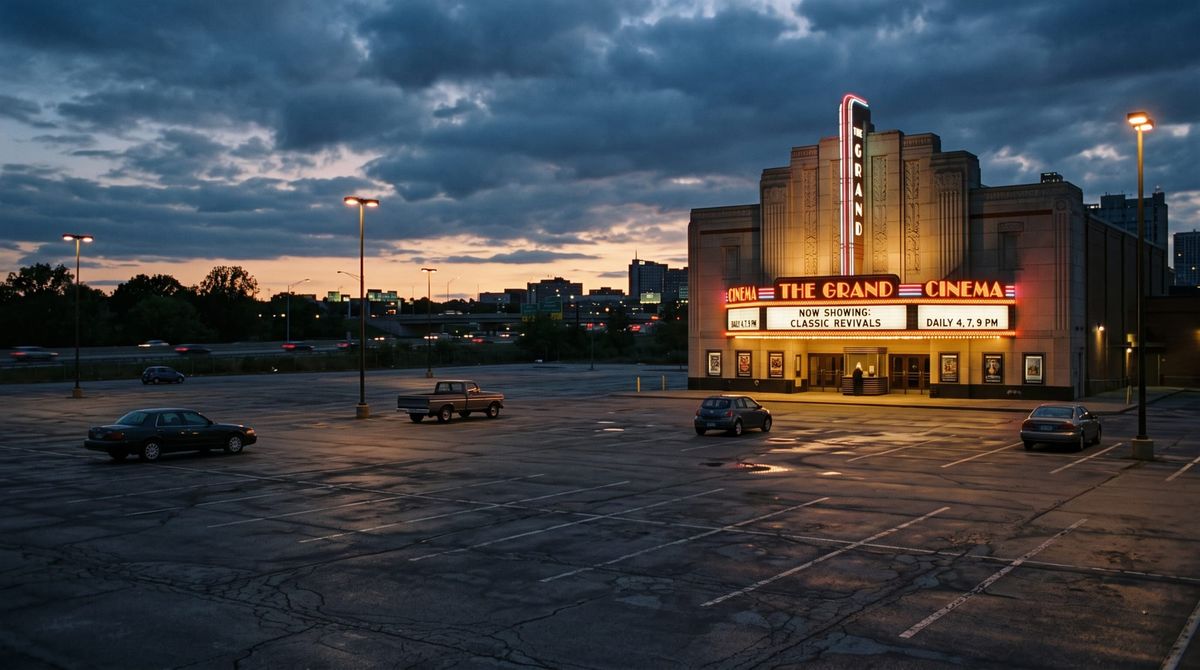
A well-known saying is that news is what happens to news reporters. As someone who writes online, I guess this applies to me, too. The "news" in question is what has happened at my local movie theater. Years ago, well before COVID, the parking lot was filled to capacity on a Saturday night, spilling over into the extra overflow lot farther away from the theater. Recently, though, the most I’ve seen is the lot barely 40% full, even when they are showing major films such as Spider-Man: Brand New Day. From where I am standing, it looks like theatrical releases are on the ropes, in an unstoppable decline, on the way to irrelevance. However, a closer look reveals the film industry is doing just fine financially. How could this be with fewer moviegoers? (And it’s not just the rise of streaming video revenue.)
The decline I observed is happening all across the United States: fewer people going to the movies. One would think that the revenues of the movie industry would be going down. After all, look at the disappearance of the frequent moviegoer. In 2019, 39% of American adults were classified as "frequent" moviegoers, attending the movies at least once a month. However, by 2025 this demographic had plummeted by 22 percentage points, dropping to just 17% of the population.
Yet, somehow the domestic summer box office generated $4.6 billion through August, representing a 26.1% increase over 2025 and landing just under the all-time summer record set in 2013. This happened in spite of the fact that total domestic admissions stood at 547.1 million, which was far below the 2019 attendance figure of 795.9 million.
Of course you know how this was done: admission prices skyrocketed. NATO (not the one with fighter jets, but the National Association of Theatre Owners, although the concept of a "bomb" is not unfamiliar to them) provides this data:
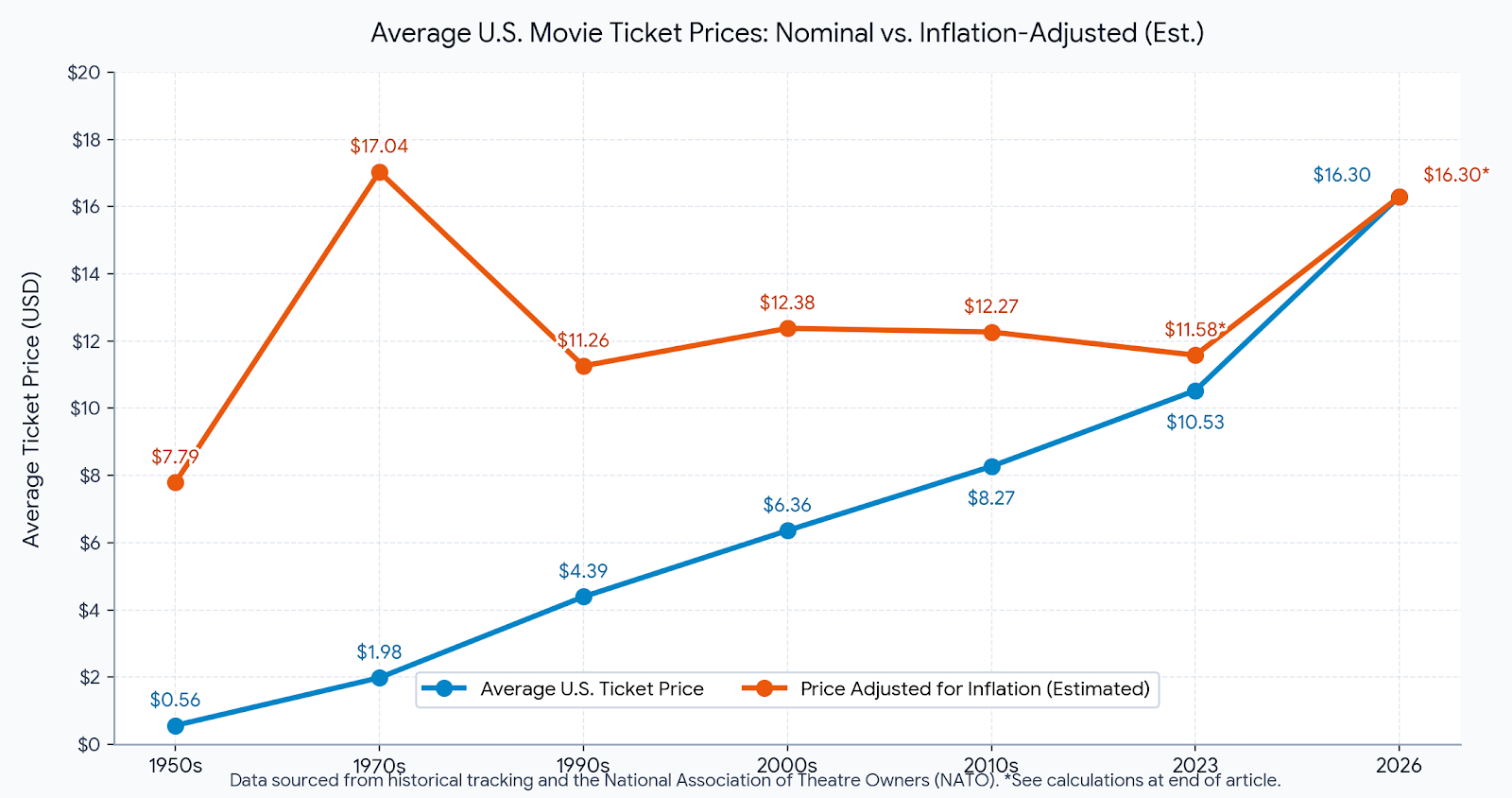
As you see, the price of movies (see blue line) since 2020 has increased precipitously. This indicates that movies are now considered a luxury item, not a staple as they once were. Incidentally, thanks to inflation, the movie price takes less of a percentage bite out of the average consumer's budget (see red line). This is small comfort, because it certainly doesn’t feel like that, thanks to inflation’s unrelenting march forward.
So how is this now a "luxury"? Well, there are those lounge chairs in movie theaters that are pretty much everywhere. In order to make room for these larger seats, theater capacity has been reduced—fewer people, with each paying more. This is reflected in the demographics of today’s moviegoer: a more gentrified audience. S&P Global surveys reveal that low-income households (earning under $50,000) dropped from 33% of moviegoers in 2019 to just 27% in 2025. At the same time, high-income households (earning $100,000 or more) expanded their share from 26% to 34%, and those earning over $200,000 grew from 11% to 16%. So what was once considered normal—a casual night at the movies—is now a high-end experience. I am forever in awe of the audacity of marketers!
Then there is streaming. I’m sure you’ve already figured that streaming has had a negative effect on attendance. In one survey, 45% of respondents gave streaming as the reason for attending cinemas less often. More tellingly, 75% of American adults reported that they had recently opted to stream a newly released movie at home instead of watching it in a theater. These viewers are not coming back, especially since home theaters will continue to improve in quality.
Finally, one must never forget about our global marketplace. There is still much room for growth globally, particularly in Southeast Asia, Latin America, and the Middle East. Gower Street Analytics projected worldwide box office revenues to reach $34.7 billion in 2026, a 16% surge over 2024, with international territories outside China driving this momentum by generating an estimated $18.38 billion. Thus, movie distributors are using a dual strategy: preserving profit margins in North America through luxury upgrades and ticket price inflation, while capturing volume and physical audience growth across the East and the Global South.
So I guess movies are here to stay; they are just going to cost more, like everything else these days. The industry, being too clever for its own good, sold us smaller rooms, higher prices, and fewer showtimes, and branded it as an "upgrade." Am I supposed to feel the increase in ticket prices was worth it because theaters offer lounge chairs? I certainly can view a movie sitting down, not lolling about like an ancient Roman aristocrat. But still, I’ll go see the occasional movie if it is interesting enough. At least it will make it easier to find a parking space across the sparsely populated blacktop.
*2023 Inflation Adjusted Calculation
A movie ticket that cost $10.53 in 2023 would cost about $11.58 in 2026 dollars. Because overall prices rose about 9.9% between 2023 and 2026, you would need $11.58 today to match the buying power of $10.53 back then.