Ukraine's New Warfare
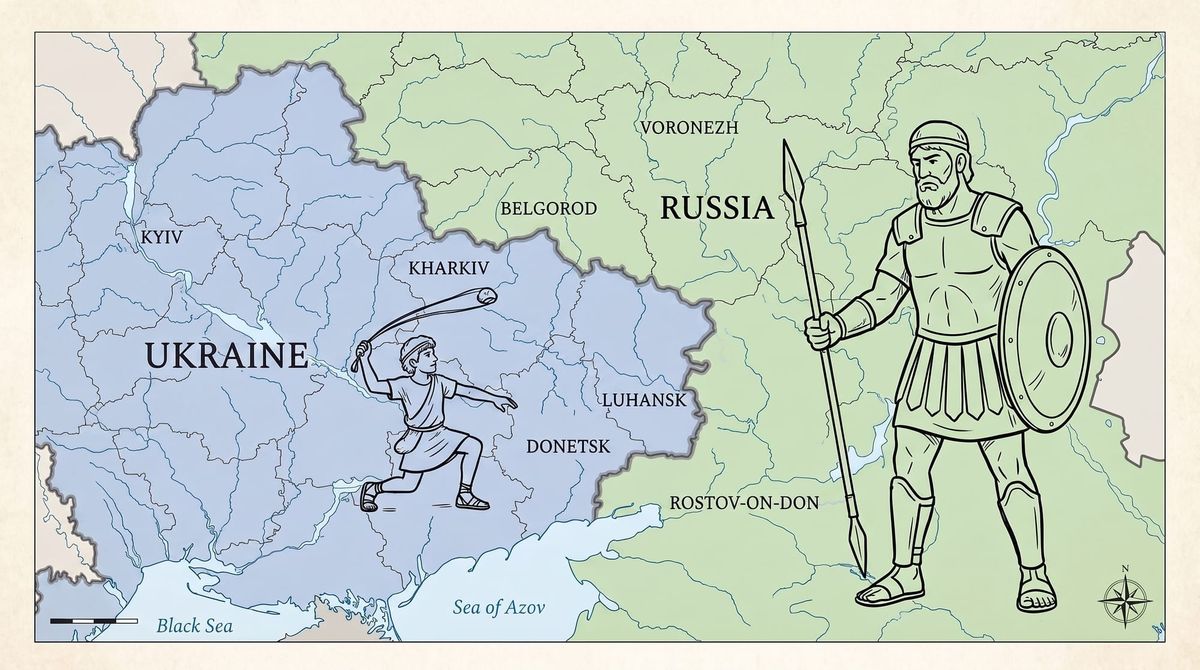
When I first heard of Russia’s invasion of Ukraine, I assumed it was over for Ukraine. Clearly, I thought, there was no way Ukraine could fight the Russian bear, and even if they did hold out, Russia would simply overwhelm them with waves and waves of soldiers. And I was not alone. President Trump felt the same way, as he made clear in an acrimonious confrontation with President Zelensky on February 28, 2025:
You're not winning this... You're buried there. Your people are dying. You're running low on soldiers... Your country is in big trouble.
Although Mr. Trump’s wording was extremely harsh, conventional wisdom was in agreement, even though, under the surface, Ukraine was already well underway in constructing its turnaround.
Fast-forward to 2026, and the story is now completely different. The expected outcome simply didn’t materialize. So what happened? How could today’s “David” possibly compete against its “Goliath”? The reasons are fascinating and would have been unfathomable to an observer in 2022.
The first surprise is the condition of the Russian military. Unbeknownst to us, Russia’s military was seriously weakened by decades of corruption, quietly hollowing out Russia's arms and matériel. Military vehicles were fitted with civilian-grade tires that failed, explosives were replaced with egg cartons, and widespread embezzlement reduced the supply of critically needed encrypted radios. These examples and numerous others severely hampered the invasion from the start.
Another weakness is Russia’s economic frailty. Even before the attacks on the Wildberries warehouses (over fifteen as of this writing), Russia's banks were under immense pressure due to high bankruptcy rates, inflation, and government mandates to fund the war effort through risky loans to defense industries. Because of this, Russia had to cancel a bond market sale because there weren’t enough buyers. Without fresh funds, the Russian government’s war plans will most likely face significant curtailment.
Meanwhile, in contrast to Russia's decline, Ukrainian technology has undergone a massive transition since 2022. There are now over 500 technology companies working on military solutions, and their handiwork shows. An absolutely amazing statistic is the prodigious drone creation:
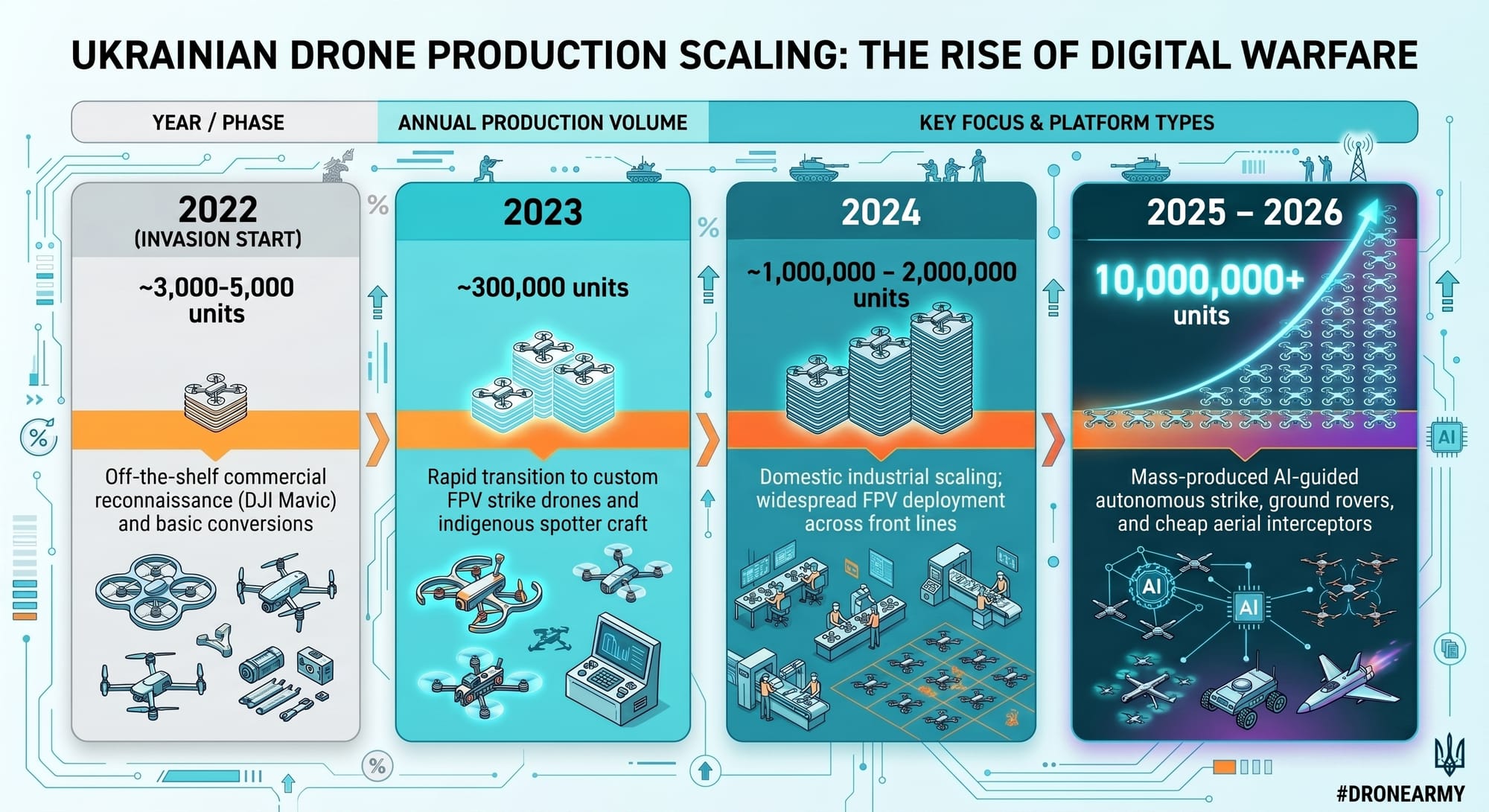
At the start of the war, Ukraine had 3,000 drones, but the end of 2026, production will reach 10 million drones annually. Note that during Zelensky’s conflict with Trump, a high production rate already existed, setting the stage for today’s control of the war. However, many drones are destroyed shortly after being made, leaving an estimated 1 million drones on hand entering 2027. Furthermore, not only does this expanding capacity give Ukraine greater flexibility when designing its campaigns, but foreign investments in its domestic production also help fund the war effort. It has become increasingly clear to other countries that Ukraine is at the vanguard of a brand-new kind of drone warfare.
But Ukraine’s technology did not stop with flying drones. They are developing land-based drones that will do the work of infantrymen. At the moment, they operate as transport vehicles to supply the front lines with matériel and are already taking on some direct combat roles. Given its success scaling aerial drones, Ukraine is well-positioned to mass-produce land-based units as well. As for the waves of Russian soldiers, they did materialize—but the technology Ukraine built prevented these forces from significantly advancing.
In retrospect, Washington’s limited help was a blessing in disguise. Any military aid from the United States was forbidden from being used to attack Russian territory; it could be used only for defensive purposes. Since Ukraine was on its own and building its own weapons, it could deploy them as it wished. Kyiv made the audacious decision to attack Russia itself, a decision too dangerous for Washington to even consider. It was shocking at the time (and to me even now!), especially since Russia was saber-rattling by implying the future use of nuclear weapons. But attack Russia they did, and now they are driving the direction of the war, with drone incursions into Russia increasing daily.
If anything, this furthers my contempt for the concept of being "on the right side of history." In 2022, “the right side” was supposedly Ukraine becoming an unwilling client state of Russia. Anyone who dared to think that Ukraine could hold out, much less have the upper hand, was considered foolishly optimistic. Ukraine didn’t stand a chance. But once again, the tortuous route of history has given us another fabulous head-fake.
Now I don’t want to be overly optimistic. The war will drag on and Ukraine will continue to suffer, as the recent August 5 missile bombardment on Kyiv demonstrated—one of the largest attacks of the war. Still, one must marvel at how Ukraine has reinvented warfare with its drone technology. In the end, history belongs not to those who forecast its arc, but to those who rewrite it through sheer determination and ingenuity.